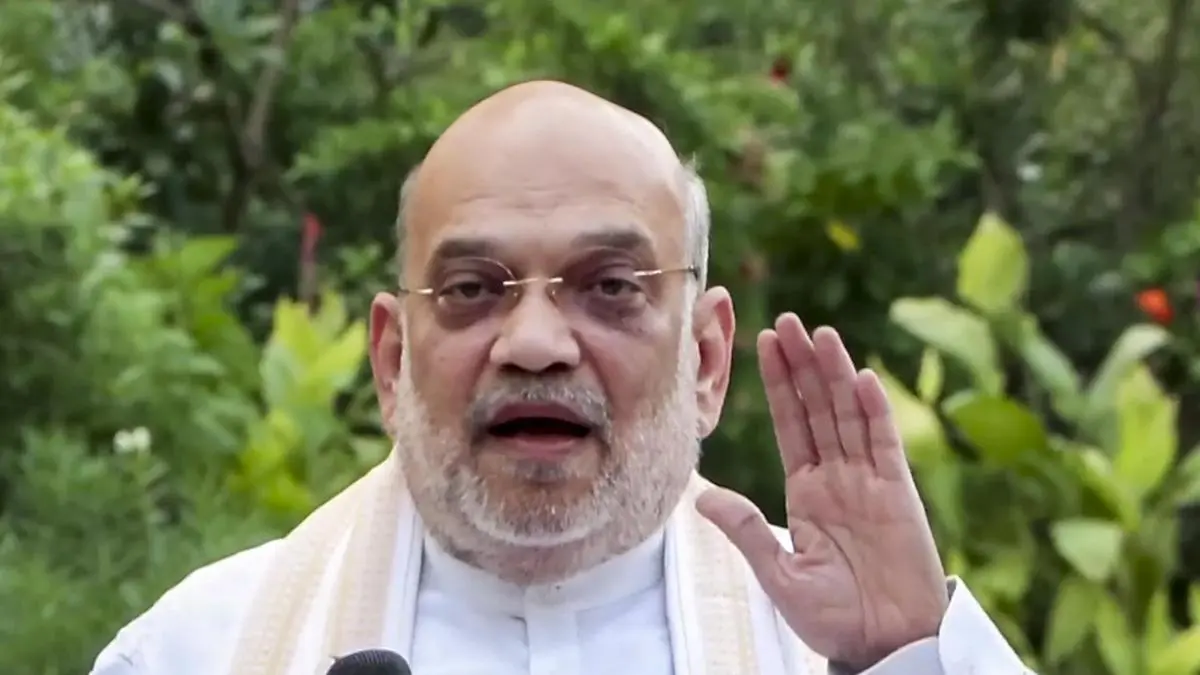
NEW DELHI – In a high-stakes press conference held on Tuesday, October 13, 2026, Union Home Minister Amit Shah mounted a vigorous defense of the Bharatiya Janata Party’s (BJP) governance model, utilizing a string of recent electoral victories to dismiss opposition challenges and reiterate the party’s long-term dominance in the national political landscape.
Addressing a packed media gallery, the Home Minister framed the BJP’s recent performance in local body and rural elections across Gujarat, Rajasthan, and Tripura not merely as regional successes, but as a resounding national mandate for Prime Minister Narendra Modi’s vision. The briefing occurred against the backdrop of intensifying street protests by opposition parties, who have demanded the resignation of Chief Election Commissioner (CEC) Gyanesh Kumar and the immediate cessation of the Special Intensive Revision (SIR) of electoral rolls.
The Core Narrative: A Mandate Refirmed
At the heart of the Home Minister’s message was a defiant rebuttal to the Congress party’s attempts to frame recent electoral shifts as a decline in the ruling party’s popularity. Mr. Shah’s rhetoric was focused on a central theme: that the "Modi guarantee" continues to hold significant weight with the Indian electorate, effectively neutralizing the narrative of anti-incumbency.
"The people of this country are firmly with Narendra Modi ji, with the BJP, and with the NDA," Shah stated. "You cannot deny this fundamental truth. These results are not just numbers; they are a clear expression of public trust."
Chronology of the Electoral Performance
To substantiate his claims, Mr. Shah provided a detailed breakdown of the BJP’s recent sweep, which he argued serves as a bellwether for the upcoming general election cycle.
1. The Gujarat Stronghold
The BJP secured a dominant victory in Gujarat, winning 90 out of 104 seats across three major urban local bodies. In the Gandhinagar Municipal Corporation, the party claimed 38 of the 44 available seats. The opposition Congress managed only five seats, while an Independent candidate secured one. Notably, the Aam Aadmi Party (AAP), which had invested significant resources into the contest by fielding candidates in all 32 seats within the Gandhinagar municipal zone, failed to secure a single seat, with all its candidates losing their security deposits.
2. Rajasthan: The Regional Sweep
In Rajasthan, the BJP’s performance was equally overwhelming. Mr. Shah highlighted that the party captured 90% of the municipal corporations, 66% of the municipal councils, and 65% of the municipalities. These statistics, he claimed, demonstrate that the BJP has successfully entrenched itself in the rural and semi-urban grassroots of the state.
3. By-election Performance in the East and South
The Home Minister also drew attention to critical by-elections in West Bengal, Tamil Nadu, and Puducherry. In West Bengal, the BJP’s wins in the Naogaon and Nandigram constituencies—and a landslide victory in Rejinagar, where the party defeated the Trinamool Congress (TMC) by a margin exceeding 75,000 votes—were highlighted as proof of the party’s expanding footprint in the state. In Puducherry, the NDA ally, the All India NR Congress, secured a decisive victory, while the Congress’s vote share was restricted to 22%.
Supporting Data: The Statistics of Success
Mr. Shah emphasized that the BJP’s success in Gandhinagar was not just a victory, but an improvement. He noted that the party saw a 10% increase in its vote share compared to the previous electoral cycle. By juxtaposing this growth with the Congress party’s historic struggles in Gujarat—where they have not held power since 1985—the Home Minister aimed to portray the opposition as a "fading force" unable to connect with the aspirations of the modern voter.
The consistency of these victories across diverse states—from the western heartland of Gujarat to the eastern periphery of West Bengal—suggests that the BJP’s electoral machinery remains in peak condition despite the passage of time since the 2024 general elections.
Confronting the Opposition: The 2029 Outlook
Perhaps the most significant takeaway from the briefing was Mr. Shah’s bold prediction regarding the 2029 Lok Sabha elections. He utilized the recent wins to project a future where the NDA returns with an even larger majority, thereby preemptively neutralizing any claims of an "opposition revival."

"I want to tell Shri Rahul Gandhi ji and his associates to prepare themselves once again for a crushing defeat in 2029," Shah remarked. "In the 2029 general elections, the NDA is going to win with a resounding majority, and the Congress is going to face its fourth consecutive defeat."
Shah’s critique of Rahul Gandhi was sharp and direct. He challenged the Leader of the Opposition to reflect on his leadership, arguing that a party that cannot win in its own historical strongholds or secure a single seat in recent by-polls has no moral standing to critique the Election Commission or the governance of the nation.
The Controversy Over the Election Commission and the SIR
The briefing addressed the growing friction between the government and the opposition regarding the Special Intensive Revision (SIR) of electoral rolls. Opposition leaders, led by the Congress, have accused the Election Commission of bias, alleging that the SIR is being used to manipulate voter demographics.
The Home Minister’s Rebuttal
Mr. Shah dismissed these allegations as "negative politics" and "fabricated media events." He argued that the Congress’s sudden focus on the SIR is a convenient deflection mechanism for their electoral failures.
"I want to ask Shri Rahul Gandhi ji directly: Is this the result of the SIR? The SIR started only after 2024," Shah pointed out. "You are losing elections because the people have rejected your ideology, not because of the electoral roll revision. You cannot win the trust of the country’s people through echoes of lies."
Furthermore, the Home Minister made a provocative allegation, suggesting that the opposition’s resistance to the SIR was motivated by a desire to keep "infiltrators" on the voter lists. By linking the opposition’s protest to national security concerns, the BJP has effectively shifted the debate from administrative procedure to a question of national integrity.
Implications for the Indian Political Landscape
The events of October 13, 2026, signal a hardening of positions on both sides of the aisle. For the BJP, the strategy is clear: double down on the image of Prime Minister Modi, leverage local electoral success to demonstrate national momentum, and frame the opposition as "anti-national" or "divorced from reality."
For the Congress and its allies, the challenge is existential. The lack of success in recent by-elections and local polls suggests that their current strategy—focused on questioning institutional integrity—is failing to resonate with the average voter. The pressure is now mounting on Rahul Gandhi to pivot from confrontational street politics toward a more constructive, policy-driven opposition if they are to avoid the "fourth consecutive defeat" predicted by Mr. Shah.
As India moves further into the current electoral cycle, the discourse surrounding the Election Commission and the legitimacy of the electoral process will likely intensify. However, if the recent results are any indication, the BJP’s ability to mobilize its base and maintain a consistent narrative remains the defining factor of contemporary Indian politics.
The coming months will be a litmus test for both the ruling coalition’s legislative agenda and the opposition’s capacity for structural self-reflection. For now, the BJP remains firmly in the driver’s seat, confident that their electoral strategy will continue to yield the results they desire as they look toward the 2029 horizon.