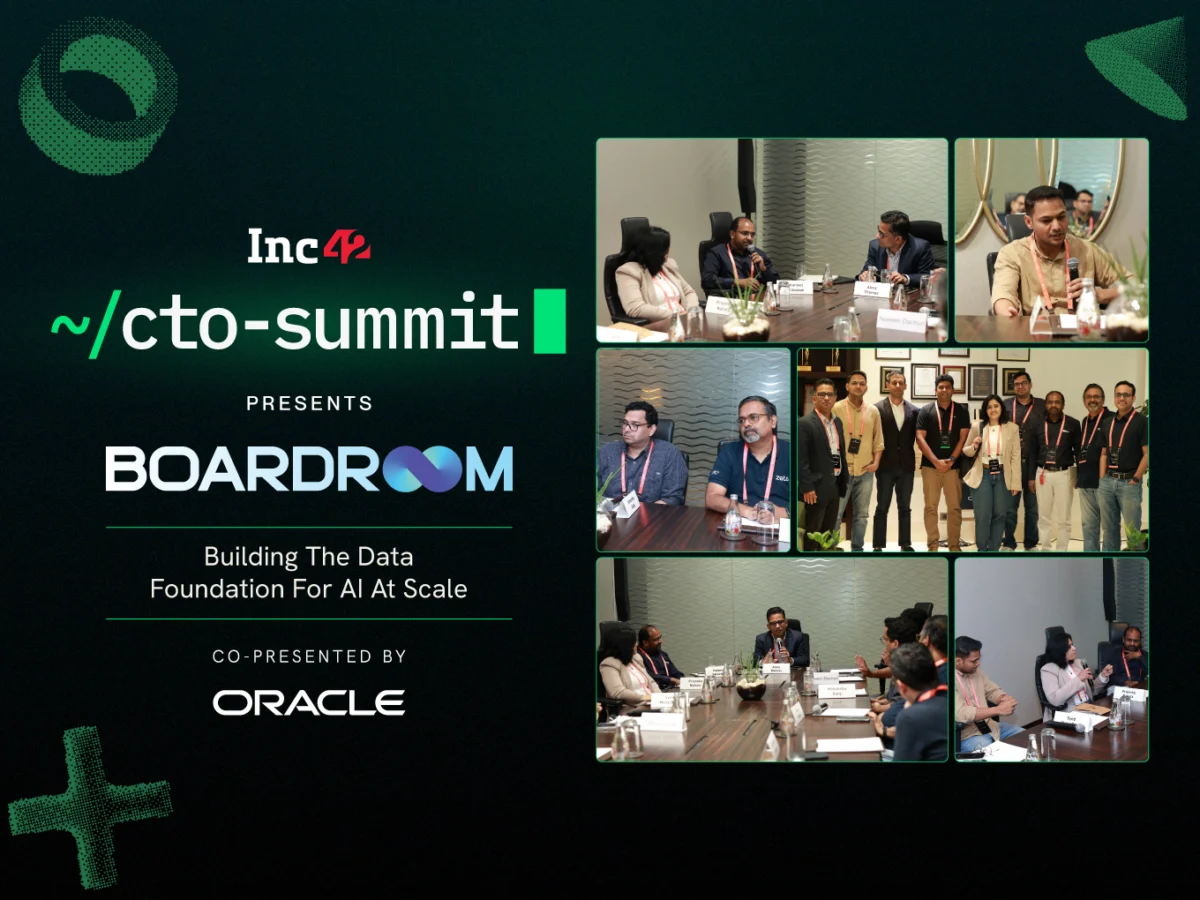
As the initial euphoria surrounding Generative AI begins to settle, Indian enterprises are confronting a sobering reality: the chasm between experimental pilots and enterprise-grade production is wider than anticipated. While the potential for AI to revolutionize operations is undisputed, the actual deployment at scale is hitting a bottleneck—not of compute, but of data maturity.
At the recent CTO Summit 2026, hosted by Inc42 in partnership with Oracle, technology leaders gathered to dissect the anatomy of the "AI Readiness Gap." The consensus was clear: enterprises have spent decades accumulating vast data estates, but this "data debt" has left information fragmented, siloed, and devoid of the context necessary for autonomous agents to function effectively.
The Core Challenge: Moving Beyond Pilot Fatigue
The current state of AI adoption in India is characterized by a "4% paradox." According to data from Dun & Bradstreet, while 73% of Indian businesses report measurable returns from their early AI investments, a mere 4% possess the data infrastructure required to support these systems at scale.
This discrepancy highlights the fundamental issue: AI systems do not merely require "data"; they require data that is discoverable, intelligible, and governed. Modern enterprises are essentially trying to build a brain (AI) on top of a nervous system (legacy databases) that is suffering from chronic disorganization. Customer identities are fragmented across disparate CRM systems, operational data is locked in functional silos, and the metadata required for AI reasoning is largely absent.
Chronology of the Discussion: From Strategy to Execution
The roundtable, moderated by Alexy Thomas, Partner at EY India, navigated the lifecycle of enterprise AI, moving from the conceptualization of business outcomes to the technical realities of semantic layers and cost-benefit analyses.
Phase 1: Outcomes Before Architecture
A recurring theme throughout the summit was the rejection of "technology-first" thinking. Leaders argued that the common failure mode is adopting a high-powered LLM (Large Language Model) and then searching for a problem to solve.
- The Problem-First Mandate: Experts like those from Orchard Healthcare emphasized working backward. Before provisioning cloud infrastructure or fine-tuning models, CTOs must define the specific business outcome. Whether it is improving customer retention or accelerating supply chain logistics, the business goal dictates the data architecture.
- The Trade-off: The panel debated the tension between "use-case-led" development—which solves immediate problems but creates technical debt—and "platform-first" development, which provides a scalable foundation but requires significant upfront investment.
Phase 2: The Semantic Layer Revolution
Once an outcome is defined, the "data-to-AI" pipeline often fails at the point of interpretation. Oracle’s representatives noted that simply plugging an AI agent into a database—be it MySQL, PostgreSQL, or a NoSQL variant—is insufficient.
- Encoding Reasoning: An autonomous agent needs to know not just what the data is, but what it means. This is where the Semantic Layer becomes mandatory. By encoding business rules and relationships directly into the data layer, organizations can ensure that agents don’t just "query" data, but "reason" about it.
- Contextual Retrieval: By narrowing the scope of information through semantic tagging, developers can significantly improve the accuracy and speed of AI agents, preventing the "hallucination" that occurs when models are forced to search through vast, unrelated datasets.
Phase 3: Governance and the "Bank A vs. Bank B" Dilemma
As AI usage spreads across departments, the question of data sovereignty becomes acute. If an agent is trained on a specific set of proprietary data, how do organizations prevent that knowledge from leaking into other workflows or third-party environments?
- Automated Guardrails: Kapture CX and other participants highlighted the necessity of "agent harnesses." These are testing and evaluation frameworks that sit between the agent and the data, ensuring that access controls are enforced at the query level.
- The Governance Imperative: The consensus was that you cannot prevent employees from using frontier AI models. Therefore, the goal is not restriction, but robust governance—applying strict access controls to the knowledge graphs and context layers that feed the agents.
Phase 4: Balancing the AI Ledger
The final pillar of the discussion was the economics of AI. As Yulu’s leadership pointed out, the distinction between internal-facing tools and customer-facing products is vital.
- Predictable Economics: For internal tasks, budgets are controllable. For customer-facing AI, unpredictable usage can lead to ballooning costs.
- Model Right-Sizing: The industry is moving away from the "one-size-fits-all" approach. Enterprises are increasingly adopting smaller, task-specific models for predictable queries (e.g., order status), reserving large, expensive frontier models for complex, high-value reasoning tasks.
Implications for the Future: The Autonomous Enterprise
The implications of the CTO Summit 2026 are profound for the Indian tech ecosystem. The transition from "AI-enabled" to "AI-first" will be defined by three key shifts:
- Data Debt Repayment: Enterprises must prioritize the cleanup of their legacy systems. Without a clean, context-rich data foundation, even the most advanced models will produce suboptimal results.
- Architectural Flexibility: Because the use cases of the future are currently unpredictable, platforms must be built to support a wide range of agents, rather than hard-coded solutions.
- Economic Discipline: The era of "AI at any cost" is ending. CTOs are now under pressure to prove the ROI of their AI stack, forcing a shift toward more efficient, smaller, and open-weight models.
Expert Insights and Perspectives
During the summit, the following perspectives emerged as industry pillars:
- On Unpredictability: Zeta’s representatives noted that with AI, the use cases are no longer strictly in the control of IT departments. As business users start deploying their own agents, the underlying platform must be robust enough to handle data requests that the CTO may not have anticipated.
- On Human Expertise: There is a growing realization that AI cannot function in a vacuum. The people closest to the data—the domain experts—must be the ones defining the semantic layers. Their intuition is what provides the context that prevents agents from making erroneous assumptions.
Conclusion: The Path Forward
The path to scaling AI in the enterprise is not a sprint; it is a systematic restructuring of how businesses store, access, and govern their information.
As the industry moves into 2026 and beyond, the competitive advantage will not necessarily go to the company with the most advanced AI model, but to the company with the most coherent data foundation. By focusing on semantic integrity, rigorous governance, and economic alignment, Indian enterprises can bridge the readiness gap and transition from the experimental phase to a future of true, autonomous operational excellence.
The message from the CTO Summit is clear: if you want to build a house for AI, stop focusing on the paint and start reinforcing the foundation.