
NEW DELHI — On the morning of October 10, 2026, the administrative heart of India’s capital, usually a thrumming hive of digital connectivity and political maneuvering, fell into an eerie technological silence. What began as a targeted police crackdown on a planned mass protest quickly escalated into a comprehensive mobile internet shutdown, paralyzing a four-kilometre radius centered on the intersection of Janpath and Kartavya Path.
The suspension of services, which lasted from 10:00 p.m. on Friday, October 9, through Saturday evening, represents the most significant communication curb in the National Capital Territory (NCT) since the widespread unrest of 2019. Beyond the immediate goal of dispersing protesters, the blackout triggered a cascade of economic and logistical failures, highlighting the extreme vulnerability of a "Digital India" when the state chooses to flip the switch.
Main Facts: A Capital Disconnected
The shutdown was not merely a local inconvenience; it was a surgical strike on the digital infrastructure of Lutyens’ Delhi. The order covered the high-security zone that houses Parliament House, the Central Secretariat, and various diplomatic missions. According to telecommunications sources and field reports, the suspension primarily targeted mobile data (4G and 5G services), while wired broadband—available mostly in government offices, luxury hotels, and established restaurants—remained operational.
This disparity created a tiered reality: while elite institutions and those within the confines of WiFi-enabled buildings could continue their operations, the "mobile-first" population—protesters, commuters, and the massive informal labor force—was effectively blinded.
Key Statistics of the Shutdown:
- Duration: Approximately 20 hours.
- Geographic Scope: A 4-kilometer radius centered on the Janpath-Kartavya Path intersection.
- Affected Services: Mobile data (all major carriers), real-time GPS updates, and UPI-based mobile payments.
- Social Media Impact: Multiple high-profile accounts withheld or blocked, including the Congress Seva Dal’s X account and B.V. Srinivas’s Instagram handle.
Chronology of a Crackdown
Friday, October 9, 10:00 PM: The Switch is Flipped
As the city wound down on Friday night, the Ministry of Home Affairs, invoking the Temporary Suspension of Telecom Services (Public Emergency or Public Safety) Rules, 2017, issued a "Top Secret" directive to telecom service providers. By 10:00 p.m., users in Central Delhi reported a sudden "No Service" or "E" (Edge) symbol on their devices. The timing was calculated to prevent the coordination of "flash protests" planned for the following morning.
Saturday, October 10, 8:00 AM – 12:00 PM: Chaos at the Barricades
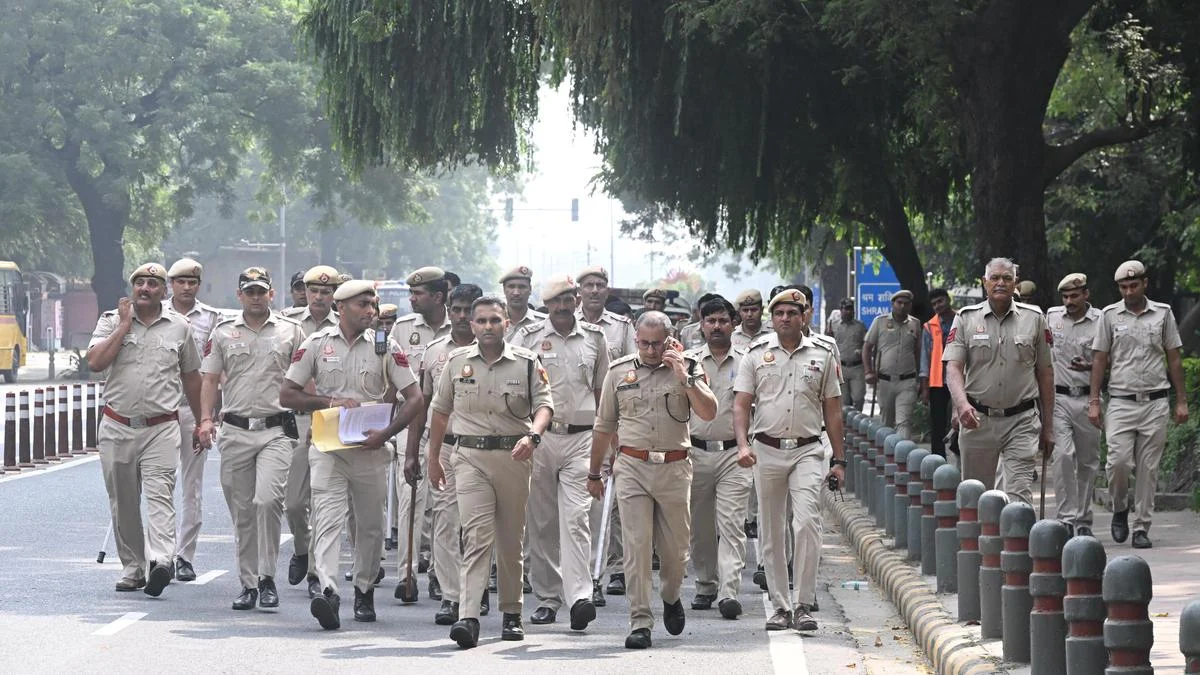
As dawn broke, security personnel, including paramilitary forces and Delhi Police, established a multi-layered cordon around Jantar Mantar and Kartavya Path. Protesters arriving at the outskirts of the zone found themselves unable to contact their peers. Groups were fragmented; without WhatsApp or Telegram, the ability to organize a cohesive demonstration evaporated. By noon, the streets were a maze of yellow iron barricades and patrolling officers, with the silence of the internet mirrored by the tense atmosphere on the ground.
Saturday, October 10, 1:00 PM – 5:00 PM: The Digital Aftershock
By mid-afternoon, the collateral damage of the shutdown became evident. The disruption moved beyond the political sphere and into the commercial lifeblood of the city. Gig workers were stranded, digital payments failed at the point of sale, and the city’s navigation systems collapsed.
Saturday, October 10, 7:00 PM: Partial Restoration
As the sun set and the threat of a large-scale evening gathering diminished, telecom operators began restoring 5G and 4G signals in phases. By 8:00 p.m., mobile data was largely back online, though users reported significant lag and intermittent drops as the network struggled to handle the backlog of queued data.
Supporting Data: The Economic and Logistical Toll
The Delhi shutdown provides a stark case study in the "side effects" of digital policing. The impact was felt most acutely in three sectors: the gig economy, digital finance, and urban navigation.
The Gig Economy Paralysis
Delhi’s service economy relies heavily on "platform labor"—delivery partners for apps like Zomato and Swiggy, and ride-hailing drivers for Uber and Ola. For these workers, mobile data is not a luxury; it is the fundamental tool of their trade.

- Stranded Deliveries: Hundreds of delivery partners reported being unable to "close" orders once they entered the 4km blackout zone. Without a data connection, the apps could not register their location, preventing them from receiving new orders or being paid for completed ones.
- The "Black Hole" Effect: Drivers reported that if they dropped a passenger off near Janpath, they had to drive several kilometers outside the zone before their apps would function again, leading to hours of lost wages and wasted fuel.
The Collapse of Real-Time Navigation
Perhaps the most unexpected fallout was the failure of Google Maps. While the satellite-based GPS signal remained active, the utility of the map vanished. Google Maps relies on crowdsourced data—the real-time movement of mobile phones—to determine traffic flow and road closures.
With the data feed cut, the app showed "clear" roads where the police had actually placed heavy barricades. Conversely, it failed to update when certain routes were reopened. This led to "navigation loops" where drivers were directed into dead ends or forced into multi-mile detours through Lutyens’ Delhi that could have been avoided with accurate data.
The Financial Freeze
In a country that prides itself on the Unified Payments Interface (UPI), the shutdown functioned as a temporary freeze on the local economy. Street vendors, petrol pumps, and small kiosks in the Janpath area were unable to process QR-code payments. Only high-end establishments with dedicated fiber-optic WiFi could facilitate transactions, further marginalizing small-scale entrepreneurs during the 20-hour window.
Official Responses and Legal Contention
The government’s justification for the shutdown remains shrouded in the "Top Secret" classification. However, the move has drawn sharp rebukes from civil society and legal experts.
The Internet Freedom Foundation (IFF)
The IFF issued a scathing statement on Saturday evening, highlighting the lack of transparency. Under Rule 3 of the Telecom Suspension Rules, the government is legally mandated to publish shutdown orders to ensure accountability.
"The communication shared by [newswire agency] ANI invokes Rule 3, yet the order itself remains hidden from the public eye under a ‘Top Secret’ label," the IFF stated. "This is a direct violation of the Supreme Court’s guidelines in the Anuradha Bhasin case, which established that any order suspending internet services must be published and is subject to judicial review."
Political Censorship
The shutdown was accompanied by targeted digital censorship. B.V. Srinivas, the chief organizer of the Congress Seva Dal, confirmed he would move the Delhi High Court after his Instagram account was blocked within India. The withholding of the Seva Dal’s X account further fueled allegations that the shutdown was not merely about "public safety" but about controlling the political narrative and preventing the documentation of police actions.
The Government’s Stance
While no formal press conference was held, sources within the Ministry of Home Affairs suggested that the curbs were "preemptive and necessary" to prevent the spread of "misinformation and inflammatory content" that could lead to a breach of peace in the high-security zone. They argued that the 4km radius was a "surgical" application designed to minimize city-wide disruption while ensuring the security of the administrative core.
Implications: The Myth of the "Safer" Shutdown
The central question remains: does shutting down the internet actually make a city safer during a protest?
The Rydzak Study and Violent Mobilization
Critics of the government’s move frequently point to a 2019 study by Jan Rydzak, then a researcher at Stanford University’s Global Digital Policy Incubator. Rydzak’s research into Indian internet shutdowns found a counter-intuitive trend: shutdowns are "much more strongly associated with increases in violent collective action than with non-violent mobilization."
The logic is that when digital communication is severed, non-violent, organized protests lose their coordination. In the resulting information vacuum, rumors spread faster, and frustrated individuals are more likely to engage in chaotic, decentralized, and often violent behavior.
A Precedent for Urban Governance
The October 10 shutdown sets a troubling precedent for the future of dissent in urban India. By using a 4km radius as a "buffer zone," the state has demonstrated its ability to create "dark zones" in the heart of the city at will.
For a global city like Delhi, which seeks to attract international investment and position itself as a tech hub, these frequent lapses into digital darkness signal a volatile regulatory environment. The "Top Secret" nature of the order suggests a shift away from the transparency promised by previous judicial rulings, moving toward a model where the "kill switch" is a primary tool of crowd control rather than a last resort.
As of Sunday morning, the barricades have been lifted and the 5G bars have returned to the screens of Delhi’s citizens. However, the economic loss for gig workers remains uncompensated, and the legal questions surrounding the "Top Secret" blackout are only just beginning to be asked in the halls of the Delhi High Court. The silence has ended, but the reverberations of the shutdown will be felt for months to come.