
By Personal Finance Desk
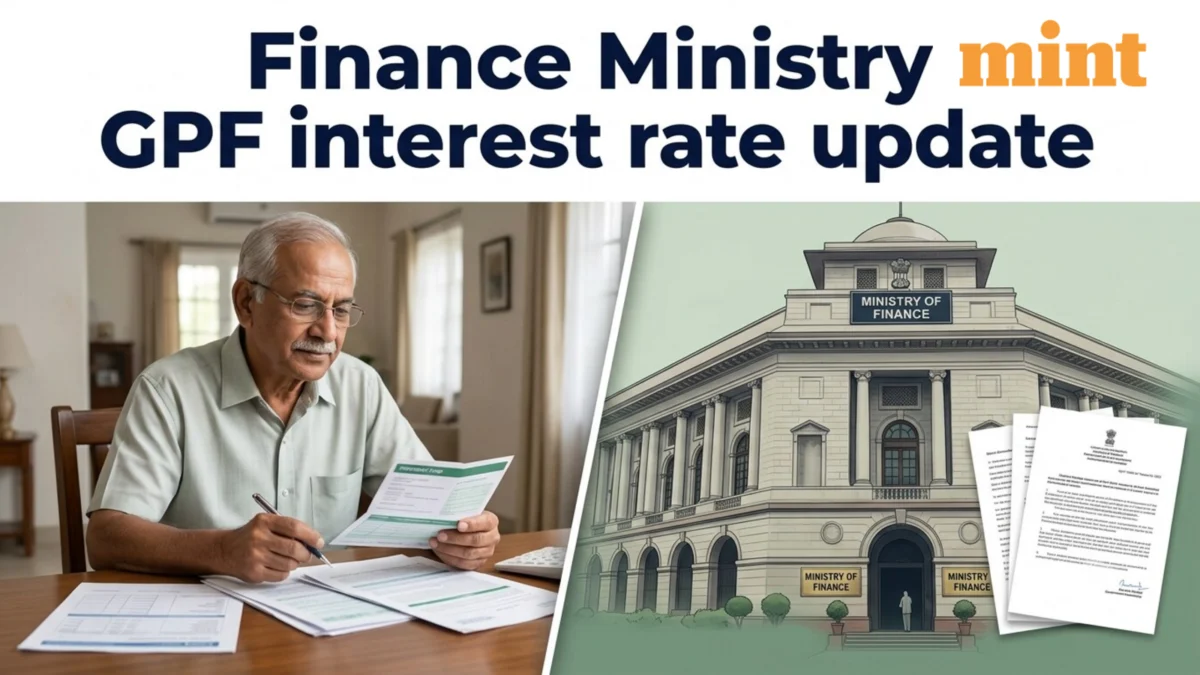
In a move that provides stability to the retirement corpuses of millions of government employees, the Union Ministry of Finance has officially announced that the interest rate for the General Provident Fund (GPF) and other associated provident funds will remain unchanged at 7.1% for the third quarter of the financial year 2026-27.
The notification, issued on October 5, 2026, confirms that the interest rate applicable for the period beginning October 1, 2026, and ending December 31, 2026, shall remain steady at 7.1%. This decision signals a continued commitment by the government to provide consistent, risk-free returns to its workforce, even as global and domestic macroeconomic conditions fluctuate.
The Core Facts: What the Notification Means
For subscribers of the General Provident Fund, the Finance Ministry’s recent circular is a reaffirmation of the status quo. The resolution states: "It is announced for general information that during the year 2026-27, accumulations at the credit of subscribers to the General Provident Fund and other similar funds shall carry interest at the rate of 7.1% (Seven point one percent) w.e.f. 1 October, 2026 to 31st December, 2026."
This rate applies to the balances held in the accounts of government employees who are eligible under the Old Pension Scheme (OPS). The decision effectively maintains the interest rate at the same level observed throughout the first two quarters of the current fiscal year (April–June and July–September), ensuring that there is no volatility in the expected returns for the subscribers during the festive season and the year-end period.
A Chronological Perspective: Consistency Over Volatility
To understand the significance of this 7.1% rate, one must look at the historical trajectory of government-backed small savings schemes.
- Q1 (April–June 2026): The government set the rate at 7.1%, maintaining a steady outlook for the start of the financial year.
- Q2 (July–September 2026): Despite shifts in market interest rates and central bank policies, the government opted to keep the GPF rate at 7.1%, prioritizing long-term stability for retirees over short-term market adjustments.
- Q3 (October–December 2026): The current notification confirms that the streak continues.
By holding the rate constant for three consecutive quarters, the Ministry of Finance has effectively insulated government employees from the immediate pressures of inflationary trends or interest rate cycles that often dictate the yields of commercial debt instruments.
Understanding the GPF Mechanism
The General Provident Fund is a cornerstone of the retirement planning ecosystem for government employees. Unlike private sector retirement vehicles, the GPF is exclusive to those under the Old Pension Scheme.
How it Works:
- Mandatory Contributions: Eligible government employees are required to contribute a certain percentage of their basic salary to their GPF account.
- Tax Efficiency: Contributions made to the GPF qualify for tax deductions under Section 80C of the Income Tax Act, making it an extremely attractive instrument for tax planning.
- Accumulated Interest: The government credits interest on a quarterly basis. Because the government is the custodian, the risk of capital loss is virtually zero.
- Withdrawals: Subscribers can access their funds during emergencies or at the time of retirement, providing a crucial liquidity safety net.
It is important for subscribers to distinguish between the GPF and the Employees’ Provident Fund (EPF). While the EPF covers the private sector and is governed by the Employees’ Provident Funds and Miscellaneous Provisions Act, the GPF is a specific mandate for government service. Consequently, the 7.1% rate announced by the Finance Ministry is not applicable to EPF subscribers, whose rates are determined by the Central Board of Trustees of the EPFO.
Implications for Government Employees
The decision to keep the interest rate at 7.1% has several long-term implications for the financial health of government staff:
1. Predictability in Retirement Planning
For an employee nearing retirement, financial planning requires a high degree of certainty. When the government maintains a steady interest rate, it allows employees to calculate their "corpus-to-be" with precision. The 7.1% rate acts as a benchmark for risk-free returns, allowing families to plan their post-retirement expenses, such as medical care and living costs, without the anxiety of fluctuating yields.

2. A Buffer Against Inflation
While 7.1% might be viewed in comparison to volatile market equities, it remains a competitive rate for a risk-free, government-backed instrument. When inflation is taken into account, the real rate of return is a vital metric. By holding the rate at 7.1%, the government ensures that the savings of its employees remain relatively protected against the eroding effects of inflation.
3. Encouraging Savings Culture
The GPF is more than just a retirement account; it is a forced savings mechanism that fosters financial discipline. For younger employees, the compounding effect of a 7.1% annual interest rate over a career spanning 30 to 35 years can result in a significant retirement nest egg. The stability of this rate encourages employees to maintain their contributions, knowing that the government stands behind the fund’s integrity.
The Broader Economic Context
The Ministry of Finance generally reviews the interest rates of small savings schemes and provident funds on a quarterly basis. These reviews are influenced by a variety of macroeconomic indicators, including:
- Government Bond Yields: The primary benchmark for small savings interest rates is the yield on government securities (G-Secs) of similar maturity.
- Inflation Targets: The government balances the need to provide fair returns to savers against the cost of borrowing for the exchequer.
- Monetary Policy: The Reserve Bank of India’s (RBI) repo rate decisions play a role in shaping the overall interest rate environment.
By keeping the GPF rate at 7.1%, the government has essentially signaled that it is comfortable with the current yield curve. It is a balancing act—providing sufficient returns to subscribers while managing the fiscal burden of interest payments.
Frequently Asked Questions (FAQs) for Subscribers
Q: Does the 7.1% rate apply to all Provident Funds?
A: The Ministry of Finance’s notification applies to the General Provident Fund and other similar funds (such as the Contributory Provident Fund, etc.) for government employees. It does not apply to the Employees’ Provident Fund (EPF) or Public Provident Fund (PPF), which have their own separate notification mechanisms.
Q: Will the rate change in the next quarter (January–March 2027)?
A: The interest rate for the GPF is reviewed every quarter. While the rate has remained stable at 7.1% throughout the first three quarters of FY27, there is no guarantee for the final quarter. The Finance Ministry will issue a new notification in December 2026 or January 2027 based on the prevailing economic conditions at that time.
Q: How can I check my GPF balance?
A: Government employees can typically access their GPF statements through their respective departmental portals or the central government’s HR management systems (like PFMS or integrated payroll systems). It is recommended to check these portals regularly to ensure that interest credits are being reflected correctly.
Conclusion: A Stable Foundation
The continuity of the 7.1% interest rate for the October–December 2026 quarter is a testament to the government’s focus on providing a secure and reliable investment avenue for its workforce. In an era where market volatility is common, the GPF remains a pillar of stability for millions.
Government employees are encouraged to continue their regular contributions and monitor their annual statements. As always, financial experts recommend that while the GPF provides a strong, risk-free foundation, it should be part of a diversified portfolio that includes other asset classes, depending on one’s age, risk appetite, and long-term financial goals.
Disclaimer: This report is for informational purposes only and is based on the recent Ministry of Finance notification. For specific queries regarding individual account balances, taxation, or rules, employees should consult their departmental administrative office or visit the official government portals dedicated to employee provident fund management.