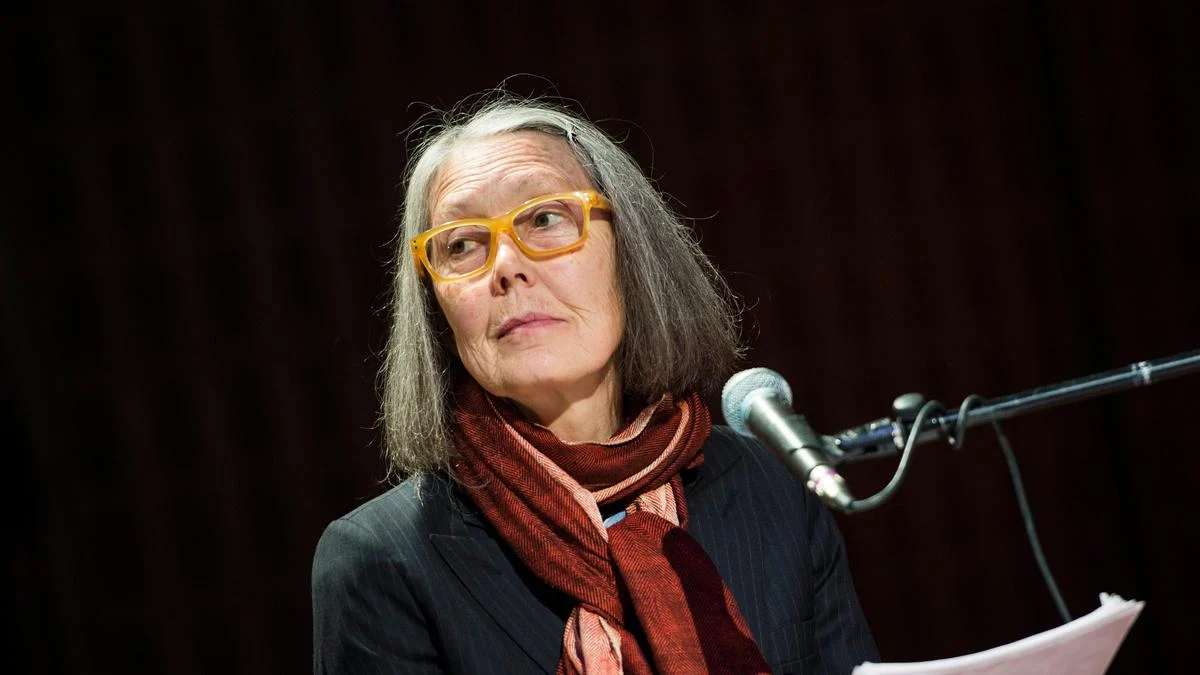
In the opening pages of her 1995 collection Plainwater, the Canadian writer Anne Carson issued a manifesto that would define her entire career: “I will do anything to avoid boredom. It’s the task of a lifetime.” When later asked by Brick, A Literary Journal why she harbors such a profound fear of the mundane, her response was characteristically stark: “Largely because it’s the condition next to death.”
This aversion to the static has fueled one of the most intellectually restless and structurally daring careers in contemporary literature. On October 8, 2026, the Swedish Academy honored this relentless curiosity by awarding Anne Carson the Nobel Prize in Literature. Yet, true to her nature, Carson received the news with characteristic irony, describing her own writing as “inadvertent.”
“Inadvertent is how I’d describe it,” she remarked during a brief exchange on the day of the announcement. “Always trying to do something else.” Eschewing the traditional glitz of the literary world, she retreated almost immediately to a forest in Iceland—a country where she holds citizenship—to spend the day with her husband, effectively severing contact with the press.
A Chronology of a Singular Mind
The Crucible of the Classics (1950–1985)
Born in Toronto in 1950, Carson’s trajectory was not immediately directed toward the literary canon. Her initial interest was visual arts, a field she pursued with passion before realizing she lacked the technical facility to translate her internal vision into drawings.
Her intellectual pivot occurred at age 15 in a shopping mall in Hamilton, Ontario, where she stumbled upon a bilingual edition of Sappho translated by Willis Barnstone. The encounter was seismic. A year later, while living in Port Hope, she discovered that her high school Latin teacher, Alice Cowan, was also a student of ancient Greek. Recognizing the spark in the young student, Cowan began tutoring Carson during lunch breaks. This humble beginning laid the groundwork for a lifelong devotion to the ancient world.
Carson went on to earn a PhD in Classics at the University of Toronto, eventually building a career as an academic polymath. She taught ancient Greek, Latin, comparative literature, and poetry at prestigious institutions across North America. For Carson, translation is not a mechanical act but a profound mental exercise. She once famously described the process as “like doing an endless crossword puzzle but with a valuable product.”
The Birth of a New Form (1986–2000)
Carson’s transition from scholar to experimental poet began with her 1986 debut, Eros the Bittersweet. Emerging from her doctoral research, the work was a revolutionary examination of desire, positioning it as a tension between longing and lack. She famously posited that a society devoid of desire is a society devoid of imagination, a theme that would echo throughout her bibliography.
By the 1990s, her work began to dismantle the boundaries between genres. Her 1992 collection, Short Talks, provides a window into her creative evolution. Originally conceived as a series of drawings, the visual elements gradually fell away, leaving behind a collection of prose poems that defied traditional classification.
In 1998, she published Autobiography of Red, a work that would cement her reputation as a transformative literary force. By reimagining the ancient Greek myth of Geryon and Herakles as a contemporary, queer coming-of-age narrative, Carson demonstrated that the past was not a tomb, but a living, breathing resource.
The Elegiac Turn (2001–2026)
As her career progressed, Carson’s work became increasingly personal, often meditating on loss and the limitations of language. The Beauty of the Husband (2001), a harrowing narrative verse about the disintegration of a marriage, earned her the T.S. Eliot Prize—a first for a woman. Nox (2010), an elegy for her brother Michael, pushed the physical boundaries of the book format, appearing as an expansive, tactile art object.
Supporting Data: The Anatomy of a Nobel-Worthy Bibliography
Carson’s influence is best measured not just by awards, but by the intellectual bridge she has built between the archaic and the modern. Her bibliography stands as a testament to the idea that form should follow the urgency of the thought.

| Title | Publication Year | Primary Genre/Form |
|---|---|---|
| Eros the Bittersweet | 1986 | Non-fiction / Criticism |
| Short Talks | 1992 | Prose Poetry |
| Plainwater | 1995 | Essays / Poetry |
| Autobiography of Red | 1998 | Novel in Verse |
| Men in the Off Hours | 2000 | Mixed Media / Poetry |
| The Beauty of the Husband | 2001 | Narrative Verse |
| Nox | 2010 | Elegy / Art Object |
| Float | 2016 | Chapbooks / Experimental |
Her work has garnered accolades from the most rigorous corners of the literary world, including fellowships from the Guggenheim and MacArthur Foundations, the Griffin Poetry Prize, and a Lannan Literary Award. Her admirers represent a cross-section of the most vital minds in contemporary letters, including Susan Sontag, Harold Bloom, and Margaret Atwood.
Intellectual Implications: Reversing the Relevance
One of the most persistent inquiries Carson faces is whether classical literature holds any relevance for the modern reader. Her response is characteristically subversive: she argues that the question itself is misplaced.
“It’s more our task to be relevant to them,” she stated in a 2026 interview. “Listen to the ancients rather than replacing them with your own ideas of how they are relevant to you.”
This stance defines her methodology. Carson does not "update" the classics to make them palatable; she inhabits their silence and allows their original, often jagged, energy to permeate her own writing. She treats Homer and Sappho not as relics, but as contemporaries, frequently remarking that the books she reads most often were published in 500 BC.
The Aesthetic of the Fragment
Carson’s work is marked by a profound economy of language. She views words as volatile, almost dangerous tools. In her own words:
“words can squirt sideways, mute and mad; you think they are tools, or toys, or tame, and all at once they burn all your clothes off and you’re standing there singed and ridiculous in the glare of the lightning.”
This tension—between the "tame" expectation of language and its capacity for violent illumination—is where Carson lives. She is a writer who understands that the truth is rarely found in polished, complete sentences. Instead, she seeks it in the margins, in the gaps between poetry and prose, and in the fragments of memory.
When asked about her tendency to write about her own life, she expressed a mix of reluctance and resignation. “I’m appalled by it,” she told the Louisiana Channel. “I am determined not to do that, but really, you have no other story to tell, no other understanding of reality except the one you’ve lived. I don’t have imagination and cannot make up stories.”
Conclusion: A Legacy Unwritten
The 2026 Nobel Prize for Anne Carson is a recognition of a writer who has spent her life refusing to settle. She has proven that literature is not a stagnant pool but a flowing, shape-shifting entity. By occupying the "unexplored, unnamed spaces between genres," she has invited her readers to look at the world with the same restless, unflinching intensity she brings to every page.
As she enters this new chapter of her life as a Nobel Laureate, it is unlikely that Carson will change her method. She will continue to read the ancients, to reject the comforts of the conventional, and to treat the act of writing as a desperate, necessary defense against the encroaching boredom of existence. For Carson, the task of a lifetime remains exactly as it was in 1995: to keep moving, to keep searching, and to ensure that the light of the intellect never goes out.