By Daniel Oropeza | Shopping Editor
October 21, 2026
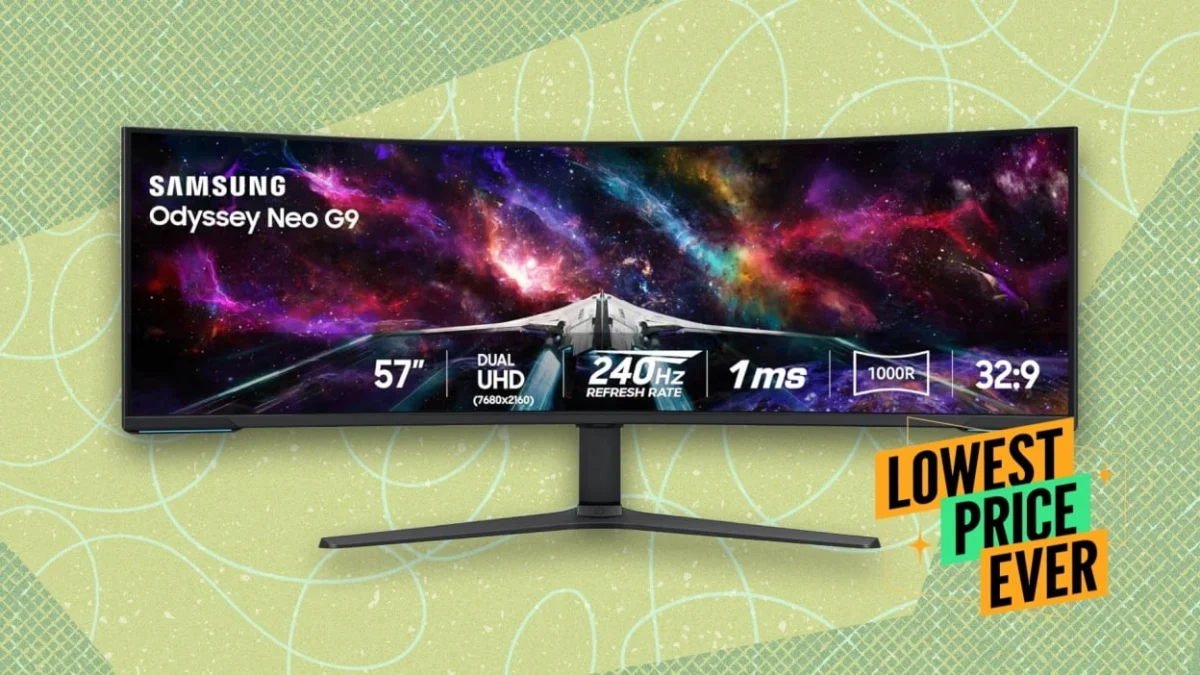
For the gaming enthusiast, the pursuit of the ultimate visual experience often leads to a singular, daunting destination: the ultra-wide monitor. These panoramic displays do more than just show games; they envelop the player, transforming a desktop setup into a cockpit of high-fidelity immersion. However, the barrier to entry for top-tier hardware has historically been prohibitive. Today, that barrier has shifted slightly. The 57-inch Samsung Odyssey Neo G9, a display that remains the gold standard for ultra-wide gaming, has hit a price point of $1,499.99—a significant reduction from its original $2,499.99 launch MSRP.
This current discount represents the second-best price ever recorded for this massive piece of engineering. As we navigate the autumn sales cycle, this offer serves as a critical junction for those deciding whether to upgrade their battlestation or wait for further market fluctuations.
Main Facts: What You Are Buying
The 57-inch Samsung Odyssey Neo G9 is not merely a monitor; it is a desktop centerpiece that demands attention. Released in 2023, it was designed to push the boundaries of what a consumer-grade display could achieve.
At its core, the monitor features a staggering 7,680 by 2,160 4K native resolution. This resolution, often referred to as "Dual UHD," effectively provides the screen real estate of two 4K monitors side-by-side without the intrusive bezel in the middle. The VA panel technology utilized here allows for a peak brightness of 1,000 nits, ensuring that HDR content—ranging from the high-contrast landscapes of Cyberpunk 2077 to the deep space vistas of Star Citizen—appears vibrant and deeply saturated.
Perhaps the most impressive specification is the 240Hz refresh rate. While many monitors boast high refresh rates, achieving 240Hz at this massive resolution requires significant bandwidth. To fully unlock the monitor’s potential, users must utilize a DisplayPort 2.1 connection. Those restricted to older standards or cables will find themselves throttled to 120Hz, which, while still smooth, fails to capitalize on the monitor’s core selling proposition.
Chronology: The Evolution of the Neo G9
To understand the significance of this $1,000 price drop, one must look at the trajectory of the Odyssey series.
- 2023 Launch: Samsung debuted the 57-inch Odyssey Neo G9 to critical acclaim. Industry analysts lauded it for its innovative Quantum Mini-LED technology, which provides precise lighting control and mitigates the "blooming" effects often associated with LED-backlit displays.
- 2024 Market Stabilization: Throughout the following year, the monitor remained a luxury item, rarely dipping below the $2,000 mark. It occupied the "prosumer" space, targeting creative professionals who needed the screen space and high-end gamers who demanded the lowest latency possible at high resolutions.
- 2025 Technological Integration: As graphics cards became more capable of handling native 8K-equivalent resolutions, the Neo G9 saw increased adoption among sim-racing enthusiasts and flight-simulation hobbyists, who require a wide field of view to simulate realistic environments.
- October 2026: We have reached the current moment. With the manufacturing costs of large-format panels stabilizing and newer display technologies entering the pipeline, the $1,499.99 price tag reflects a strategic move to clear inventory and capture the "early Black Friday" consumer segment.
Supporting Data: The Technical Hurdle
The primary caveat for any prospective buyer of the Samsung Odyssey Neo G9 is the hardware dependency. This is not a "plug and play" device for the average laptop user.
To run a game at 7,680 x 2,160 at 240Hz, your graphics card is tasked with rendering an enormous number of pixels per second. According to benchmarking data from recent hardware reviews, even current-generation flagship GPUs (such as the RTX 50-series or equivalent top-tier AMD offerings) will struggle to maintain 240 frames per second in graphically demanding modern titles without the heavy assistance of AI-driven upscaling (such as DLSS or FSR).

If you are using an older GPU, you will likely be forced to lower your resolution or graphical settings to achieve a playable frame rate. Consequently, the monitor acts as a catalyst for a total system overhaul. If your current rig is powered by a mid-range card from three years ago, the $1,499 investment in the monitor must be weighed against the potential $1,000+ investment in a new GPU to actually utilize the hardware.
Official Responses and Industry Reception
Upon its release, the tech community was nearly unanimous in its praise. PCMag awarded the device an "Excellent" rating, highlighting that while the size is intimidating, the color accuracy and contrast levels are virtually unmatched in the VA-panel category.
Samsung’s official marketing has focused heavily on the "immersive" aspect of the curvature. The 1000R curve is designed to match the natural curvature of the human eye, which theoretically reduces eye strain during long gaming sessions. However, professional ergonomics experts often note that for a screen of this size, the user must sit at a specific, calculated distance to reap the benefits of that curve. If you are too close or too far, the perspective distortion can actually become a hindrance rather than a benefit.
Implications: Is This Right for You?
The decision to purchase this monitor is less about the deal itself and more about your personal workflow and gaming habits.
The Case for the Enthusiast
If you are a professional who spends hours in video editing timelines or a serious sim-racer who needs the maximum possible field of vision, the $1,499 price point is an incredible value. The ability to snap four distinct windows into view without overlapping is a productivity multiplier. For gaming, the sensation of "filling" your peripheral vision is a transformative experience that standard 16:9 or even 21:9 monitors cannot replicate.
The Case for the Casual Gamer
If your gaming habits revolve around titles like League of Legends, Valorant, or Counter-Strike, this monitor is arguably overkill. These games rely on twitch reflexes and high frame rates, which are better served by 240Hz or 360Hz displays that prioritize pixel response times over raw screen real estate. Furthermore, the sheer size of the 57-inch panel may actually be a disadvantage in competitive play, where you need to track the entire screen with minimal head movement.
For those who find the Neo G9 too extreme, the market currently offers excellent alternatives. For example, high-quality 32-inch or 34-inch Asus gaming monitors, currently retailing around $329.99, provide a more traditional gaming experience that balances performance, cost, and physical space requirements.
Final Verdict
The $1,499.99 price tag for the Samsung Odyssey Neo G9 is a compelling siren song. It is a premium, top-of-the-line piece of technology that has finally entered the "attainable" range for the dedicated enthusiast. Before pulling the trigger, however, take a moment to measure your desk, check your GPU’s specifications, and ensure your system can handle the sheer visual weight of this monitor. If your system is ready, this is an upgrade that will fundamentally change how you interact with your digital world.
As we approach the end of 2026, keep a close watch on these price-checking tools; while $1,499 is a fantastic price, the retail landscape remains fluid. Always ensure you are purchasing from authorized retailers to maintain the integrity of your warranty and support, as a device of this complexity warrants the peace of mind that comes with official manufacturer backing.