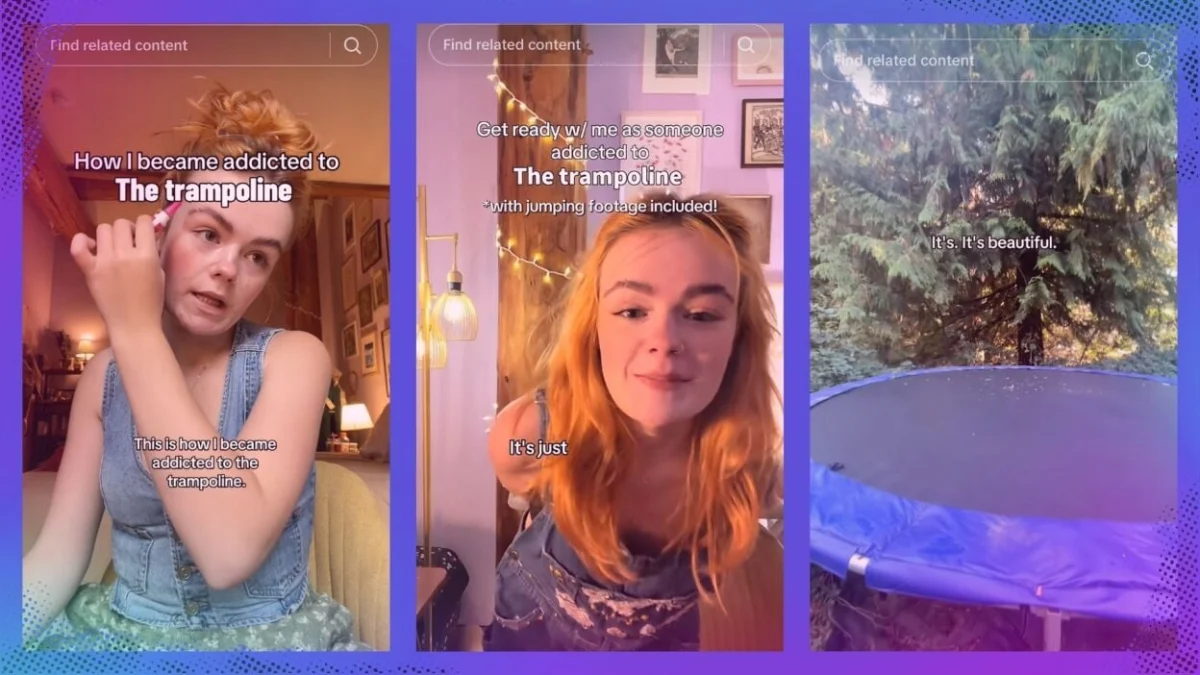
In a digital landscape saturated with high-intensity productivity hacks, algorithmic wellness trends, and the relentless pressure to monetize every waking hour, one TikTok creator has found internet fame by doing the exact opposite.
Meet the woman behind the handle @whatifimjustagirl, who has captivated millions by sharing a nightly ritual that borders on the surreal: for the past seven years, she has spent nearly every night—usually between the hours of midnight and 3 a.m.—jumping on a backyard trampoline. While the rest of the world is either sleeping or doom-scrolling, she is engaged in a rhythmic, solitary practice under the stars.
Her content has sparked a broader conversation about modern joy, the diagnostic gaze of social media, and the radical act of reclaiming one’s own time.
The Ritual: A Midnight Escape
For @whatifimjustagirl, the trampoline is not a fitness apparatus, nor is it a prop for a choreographed dance routine. It is, by her own admission, a sanctuary. The routine is remarkably consistent: she heads outside in the dead of night, often equipped with nothing more than comfortable loungewear—leggings and a flannel on cooler evenings—and a pair of headphones.
The activity is entirely unscripted and unstructured. There are no performance metrics, no set calorie-burning goals, and no social audience invited to the trampoline itself. It is a deeply personal endeavor that has survived nearly a decade of life changes, weather fluctuations, and the transition from private hobby to public spectacle. "I look forward to it every single day," she shared in a recent video, a sentiment that resonates with viewers who find her commitment both bewildering and deeply enviable.
Chronology of a Viral Obsession
The journey from a solitary backyard habit to a viral sensation was not overnight, but rather a slow-burn discovery by the TikTok algorithm.
- 2019–2024: For several years, the creator maintained her ritual in near-total obscurity. The practice served as a consistent anchor during her personal life, providing a physical outlet for nervous energy and a meditative space to decompress.
- Early 2026: The creator began documenting her routine, initially as a way to share her unique lifestyle with a small following.
- October 2026: A series of videos explaining her "why" went viral, amassing millions of views. The contrast between the mundane nature of the act and the intensity of her commitment triggered a wave of curiosity, confusion, and, eventually, widespread admiration.
- Mid-October 2026: The discourse shifted from "who is this?" to "what does this mean?" as the creator was forced to address the internet’s relentless desire to label and diagnose her behavior.
The Diagnostic Gaze: Mental Health and Social Media
One of the most significant implications of this story is the modern tendency for social media users to pathologize unconventional behavior. As the creator’s videos gained traction, the comment sections were quickly flooded with amateur diagnoses. Many viewers, observing her repetitive movement and intense dedication, speculated that she was neurodivergent, specifically identifying her routine as a potential form of "stimming" associated with autism.

In a candid follow-up video, the creator addressed these assumptions with grace and firmness. She clarified that she does not have autism, though she does live with OCD. She noted that while her OCD may influence her attachment to the routine, it is not the primary driver of the behavior.
"Yes, is my obsession with the trampoline a little extreme? Yes," she acknowledged. "Does my OCD play a factor in that? Yes, but that’s not why I jump. I don’t think there needs to be a diagnosis [for it]."
This exchange serves as a poignant reminder of the "diagnostic culture" prevalent on platforms like TikTok, where users often project medical frameworks onto creators to make sense of behaviors that deviate from the social norm. By refusing to let her hobby be defined by a medical label, the creator has asserted a powerful stance: some things are done simply because they bring joy, and they do not require a clinical explanation.
The Science of Joy: Why We Bounce
While the creator rejects the need for a medical diagnosis, there is a legitimate psychological and physiological basis for why a repetitive, rhythmic activity like jumping can be so profoundly grounding.
Human beings have long utilized rhythmic movement to regulate their nervous systems. From the swaying of a rocking chair to the repetitive steps of a long-distance run, rhythmic motion is inherently soothing. Trampolining, in particular, engages the vestibular system—the sensory system that provides the leading contribution to our sense of balance and spatial orientation.
For many, the physical sensation of "rebounding" creates a state of flow, a psychological state described by psychologist Mihaly Csikszentmihalyi as being completely involved in an activity for its own sake. In this state, the ego falls away, time flies, and every action, movement, and thought follows inevitably from the previous one. By jumping in the middle of the night, the creator is likely tapping into a deep, meditative flow state that allows her to disconnect from the stressors of the day.
The Implications: A Rebellion Against Optimization
Perhaps the most striking aspect of this story is how it challenges the modern "hustle culture" that permeates social media. We live in an era of "productivity porn," where every hobby must be optimized. If you run, you should train for a marathon. If you write, you should be building a Substack. If you have a backyard, you should be growing a vegetable garden to cut grocery costs.

The creator’s trampoline routine acts as a form of "quiet rebellion." She isn’t monetizing her bounce, she isn’t losing weight for a competition, and she isn’t creating content to sell a lifestyle brand. She is simply existing in a state of play.
This refusal to be productive is what makes her so magnetic to her audience. In a world that demands we constantly "level up," there is something deeply subversive about an adult spending two hours in the dark, bouncing on a trampoline, and calling it a night. It invites the audience to ask themselves: What is the one thing I do that serves no purpose other than making me feel good?
Conclusion: Finding Your Own "Trampoline"
The story of the midnight jumper is more than just a fleeting viral trend; it is a mirror reflecting our own collective exhaustion. We are a society that has forgotten how to be bored, how to be silly, and how to occupy our own company without the interference of a screen or a goal.
While not everyone has the space, the physical ability, or the tolerant neighbors required to adopt a nighttime trampoline habit, the underlying principle is universal. We all need a mechanism to discharge the day’s tension. For some, it might be a midnight walk, a late-night painting session, or even just sitting on a porch watching the world go by.
As the creator continues her seven-year streak, she offers a simple, albeit unconventional, lesson: Happiness isn’t always found at the end of a long, optimized to-do list. Sometimes, it’s just a matter of finding a quiet space, blocking out the noise of the world, and letting yourself move, jump, and exist—even if it’s at 2 a.m.
In the end, she hasn’t just figured out a routine; she has figured out how to preserve her own sense of wonder in a world that tries very hard to strip it away. And in doing so, she has invited us all to take a leap of faith—or at least, a jump on a trampoline.