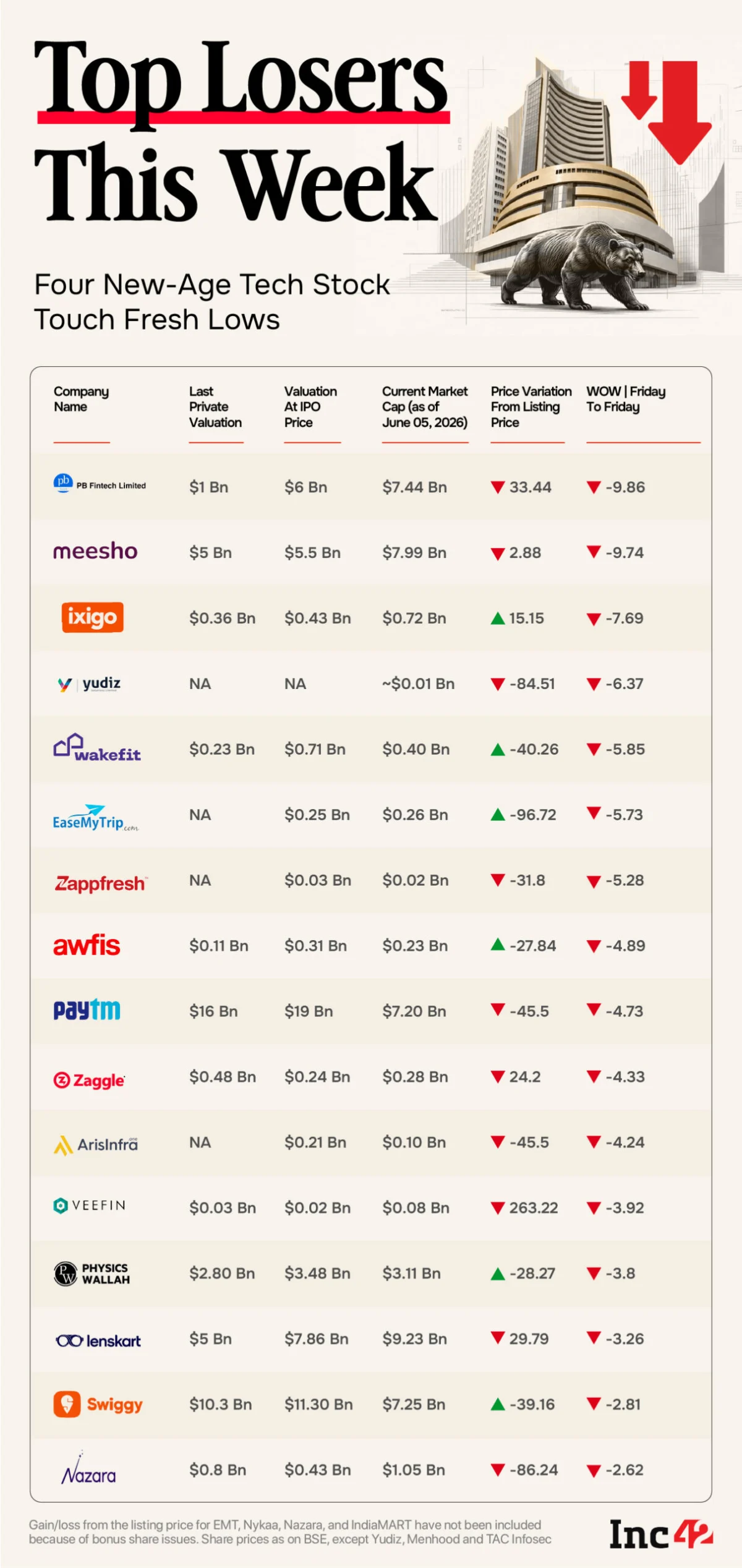
The Indian new-age tech landscape experienced a week of pronounced volatility, characterized by a sharp bifurcation in investor sentiment. Amidst broader market turbulence fueled by persistent geopolitical tensions and macroeconomic uncertainty, the 57 new-age tech stocks tracked by Inc42 exhibited a mixed performance. While 31 stocks faced downward pressure, with declines ranging from 0.03% to nearly 10%, a resilient group of 26 companies managed to buck the trend, posting gains between 0.04% and 16%.
This performance unfolded against the backdrop of a cooling broader market, where both the Nifty 50 and the Sensex shed over 0.5% to close at 23,366.70 and 74,243.34, respectively. As institutional investors recalibrate their portfolios in response to RBI policy updates and global economic cues, the tech sector remains a focal point for both opportunistic buying and cautious divestment.
Chronology of Market Movements: The Highs and The Lows
The past week served as a litmus test for market confidence, with several high-profile companies reaching critical inflection points.
The Bearish Sentiment: PB Fintech and Meesho
The week’s primary laggard was PB Fintech, which saw its shares plummet by 9.86% to close at ₹1,534.6. The decline was largely precipitated by comments from Chairman Yashish Dahiya, who voiced concerns regarding potential regulatory changes—specifically, the IRDAI’s proposed caps on distributor commissions. The market reacted swiftly to this regulatory uncertainty, reflecting the sensitivity of fintech aggregators to policy shifts.
Similarly, Meesho continued a grueling downward trajectory, marking its ninth consecutive session of losses. Ending the week at ₹165.85, the e-commerce major faced a weekly decline of 9.74%. Analysts at Choice Institutional Equities pointed to the impending expiry of the six-month lock-in period (June 9) as the primary catalyst for the sustained selling pressure, as institutional shareholders prepare for potential exits.
The Bullish Outliers: BlueStone and CarTrade
Conversely, BlueStone emerged as the week’s standout performer. Driven by an aggressive growth projection unveiled in its latest investor presentation—aiming for ₹12,000 Cr in revenue by FY30—the jewellery retailer’s shares surged 15.99% to close at ₹554.85.
CarTrade also enjoyed a strong week, climbing 12.84% to ₹1,960.45. This rally was bolstered by a significant rating upgrade from Kotak Institutional Equities, which moved the stock from "SELL" to "BUY," simultaneously raising its price target to ₹2,300.

Other notable mentions touching fresh highs included Kissht, Aye Finance, RateGain, Ather Energy, SEDEMAC, MobAvenue, and ideaForge.
Strategic Developments and Corporate Maneuvers
Beyond the ticker tape, the week was defined by a flurry of capital raising, acquisitions, and regulatory developments that are likely to reshape the competitive landscape for these firms.
- Capital Infusions: Ola Electric successfully concluded its Qualified Institutional Placement (QIP) at ₹780.24 Cr, securing backing from global powerhouses like Goldman Sachs and domestic heavyweights like Motilal Oswal. Meanwhile, Nazara Technologies completed a preferential issue worth ₹474 Cr, drawing participation from the S Gupta Family Enterprises and Plutus Investments.
- Expansion and Acquisitions: ixigo signaled an aggressive growth strategy by securing board approval to acquire stakes in Brevistay (hotel bookings), ProctAI (AI surveillance), and Vestra (agentic AI). Zappfresh also doubled down on its expansion, acquiring 100% of its subsidiary, Avyom Foodtech, for ₹10 Cr.
- Regulatory and Operational Hurdles: Awfis faced a fresh GST show-cause notice regarding discrepancies in its FY23 filings, with a tax demand of approximately ₹7.1 Cr. On the fintech front, Paytm moved to scale its lending business by establishing Default Loss Guarantee (DLG) arrangements of ₹90 Cr each with Muthoot Fincorp and Kisetsu Saison, aiming to align with RBI’s stringent lending protocols.
- The IPO Pipeline: The D-Street excitement continues as PRISM (OYO) received SEBI approval for its confidentially filed Draft Red Herring Prospectus (DRHP), while the entertainment brand Kuku FM pre-filed its IPO papers, indicating that the primary market remains an attractive route for unicorn-stage companies.
Macroeconomic Context: The RBI and The Broader Market
The broader market decline was heavily influenced by the Reserve Bank of India’s (RBI) recent Monetary Policy Committee (MPC) announcement. While the repo rate was held steady at 5.25%, the central bank’s commentary struck a note of caution.
The RBI revised its FY27 inflation forecast upward to 5.1% (from 4.6%) and tempered its GDP growth projection to 6.6% (from 6.9%). Governor Shaktikanta Das highlighted risks associated with elevated energy prices, supply-side shocks, and the unpredictable impact of monsoon patterns—factors that have dampened investor enthusiasm.
Despite this, the domestic economy shows pockets of strength. Provisional GDP data released late in the week revealed a robust 7.7% growth for FY26, with the Q4 FY26 figure standing at 7.8%. This data provided a necessary buffer for the market, preventing a more severe sell-off during a week dominated by global uncertainty and volatile oil prices.
Deep Dive: Growth Drivers for BlueStone and ideaForge
BlueStone’s Path to 5X Growth
BlueStone’s stellar performance is rooted in a clear, ambitious roadmap. Having achieved its first profitable fiscal year in FY26, the company is pivoting toward an aggressive offline retail expansion. The projection of ₹12,000 Cr in revenue by FY30 represents a 5X jump from its current ₹2,486 Cr revenue base.
The strategy rests on two pillars:

- Same-Store Sales Growth (SSSG): The company expects a 30% CAGR in existing store performance.
- Network Expansion: New store additions are slated to drive a 20% CAGR.
Brokerages like JM Financial and Nuvama maintain a "BUY" rating, noting that while BlueStone utilizes its D2C platform for customer acquisition and discovery, the actual conversion—the "touch and feel" aspect of high-value jewellery—remains heavily skewed toward its physical retail footprint.
ideaForge and the Defence Tech Tailwind
The surge in ideaForge shares (up 11.61% to a 52-week high of ₹943.5) was catalyzed by a dual-engine of corporate strategy and national policy. The company’s board approved a ₹500 Cr fundraise to accelerate R&D and modernization.
This coincided with reports of India’s largest-ever military drone procurement program, valued at over $2 Bn. With the government’s explicit ban on foreign drone imports to foster the "Make in India" initiative, ideaForge is uniquely positioned to capture significant market share in the domestic defense sector. The strategic shift toward unmanned warfare is no longer just a trend but a policy-driven mandate, providing a long-term runway for indigenous drone manufacturers.
Implications for Investors
The market’s performance this week highlights a shift from "growth at all costs" to "profitable, sustainable growth." Companies like BlueStone that offer clear, data-backed paths to scaling are being rewarded, while firms facing regulatory headwinds or lock-in expiries (like PB Fintech and Meesho) are seeing their valuations tested.
For the retail and institutional investor, the takeaway is clear: the current market environment demands a granular approach. As geopolitical tensions linger and the RBI maintains a vigilant stance on inflation, the "new-age" tech sector is no longer a monolith. Investors should look for companies with:
- Regulatory Resilience: Businesses that can navigate, rather than fear, government policy changes.
- Operational Discipline: Companies that have moved past the cash-burn phase and are demonstrating positive unit economics.
- Strategic Moats: Companies like ideaForge that are tied to long-term national growth themes, such as domestic manufacturing and defense self-reliance.
As we look toward the coming weeks, the volatility is unlikely to abate immediately. However, the divergence between the winners and losers this week underscores that in a maturing tech ecosystem, fundamentals—not just hype—are once again the primary driver of market capital.