
In the high-stakes world of professional sports, success is rarely left to chance. If you walk into the locker room of an elite franchise or the training facility of a championship college program, you are immediately struck by a deliberate, almost sacred aesthetic. The walls are not merely painted; they are "tattooed" with core precepts. Motivational quotes, retired jerseys, statues of legends, and framed snapshots of defining victories serve as a constant, silent chorus of expectations.

This is not simple interior design; it is psychological engineering. These teams understand that human focus is fickle. By saturating an environment with physical reminders of values and standards, they transform abstract ideas into tangible reality.

Author and strategist Ryan Holiday has adopted this philosophy for his own workspace. His office is not merely a room for labor, but a curated sanctuary of totems—physical objects that serve as anchors for his professional and personal identity. By surrounding himself with these artifacts, he constructs an "architecture of intent," ensuring that his daily work aligns with his long-term values.

The Anatomy of a High-Performance Workspace
To understand how a physical environment can shape human behavior, one must look at the specific items that populate a high-performance office. Holiday’s collection serves as a case study in how to bridge the gap between abstract philosophy and daily output.

1. The Power of "No": Guarding the Gate
One of the most prominent features in Holiday’s office is a photograph of the late polymath Oliver Sacks. In the image, Sacks is on the phone, while a prominent sign behind him reads, simply: "NO!"

Holiday pairs this with historical artifacts: memos from President Harry S. Truman. In one, Truman explicitly outlines his policy of refusing to answer unsolicited inquiries, prioritizing his limited time and remaining capacity. For the modern knowledge worker, this serves as a critical lesson in trade-offs. As one’s career gains momentum, the volume of inbound requests—emails, meetings, appearances—becomes an existential threat to output. Holiday notes that every "yes" to an external demand is effectively a "no" to his family and his writing. The sign serves as a daily defense against the dilution of his most impactful work.

2. The Library as a Room of Mentors
Cicero once posited that a house without books is like a body without a soul. Holiday takes this further, filling his space with thousands of volumes. He views his library not as a storage solution, but as a "room full of mentors."

In an era of digital ephemera, physical books serve as an anchor. They represent the best thinking of the last several millennia, waiting patiently on the shelf to be consulted. By surrounding himself with these physical texts, Holiday creates an environment where wisdom is not just an idea, but a palpable, reachable resource.

3. The "Good Steward" Mandate
Success brings a unique trap: the temptation to optimize for profit rather than mission. Taped to his wall is a simple notecard that asks, "Am I being a good steward of Stoicism?" This is his "Why." Despite the commercial success of his books and platforms, he uses this note to filter every decision. If a business strategy threatens the integrity of the philosophy he advocates, the answer is a hard rejection. It is a reminder that business is a vehicle for mission, not the other way around.

Chronology of Influence: From Artifacts to Action
The objects in Holiday’s office represent a timeline of lessons learned. This is not a static collection; it is a living, evolving narrative.

- 2017: A Grammy Award certificate serves as a reminder of the ephemerality of external validation. The inscription reads: "When you die, this will go in the trash alongside all your other ‘accomplishments.’" It is a sobering check on ego.
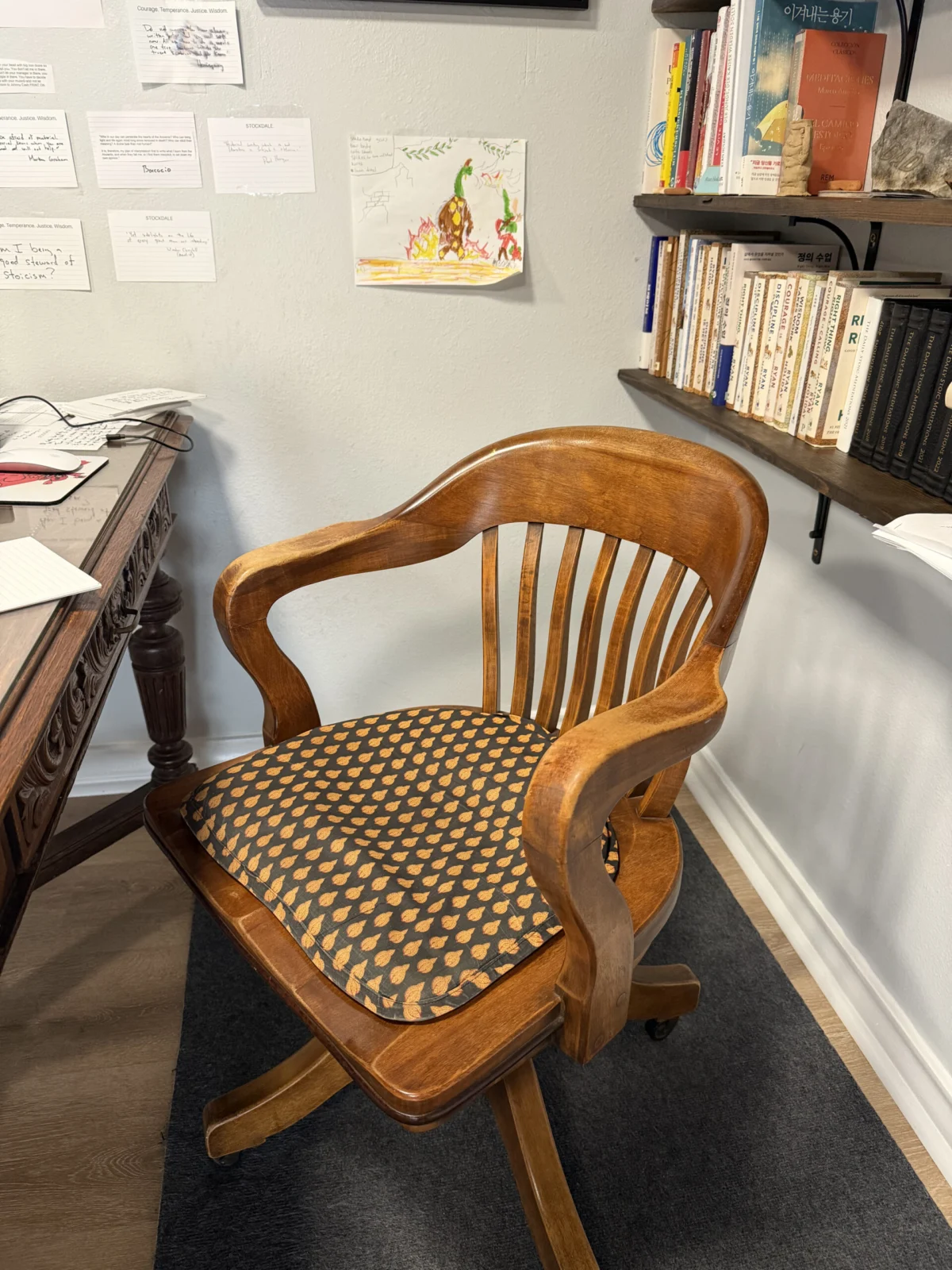
- The Post-Didion Era: Holiday’s acquisition of Joan Didion’s writing chair links him to a lineage of literary giants. Sitting in that chair, he is forced to confront the gravity of his craft and the responsibility of the tradition he carries.
- The Ongoing Practice: The constant accumulation of handwritten notecards—a modern "second brain"—bridges the gap between the ancient advice of Pliny the Elder ("Never read without taking extracts") and the complex problem-solving of the 21st century.
Supporting Data: The Psychological Efficacy of Environmental Priming
The strategy of using "environmental triggers" is backed by significant research in cognitive psychology. Known as environmental priming, this concept suggests that the cues in our immediate surroundings influence our decision-making processes and cognitive load.

When a writer or an athlete surrounds themselves with symbols of discipline—such as the Four Virtues (Courage, Temperance, Justice, Wisdom) or the "Sense of Urgency" signs inspired by culinary legend Thomas Keller—they are essentially performing a daily ritual of recalibration.

Research from the University of Michigan indicates that "visual cues" can reduce the "decision fatigue" often associated with high-level creative work. By having a pre-determined answer to questions of character and ethics—represented by these physical objects—individuals spend less energy debating their own standards and more energy executing their work.

Official Perspectives and Philosophical Implications
The broader implications of this approach suggest a shift in how we define a "productive" workspace. It moves beyond the ergonomic chair or the high-speed monitor toward a space that manages the mind.

The Role of Memento Mori
The presence of a chunk of a Victorian tombstone marked "Dad" serves as the ultimate equalizer. It is a literal manifestation of Memento Mori—the Latin practice of reflection on mortality. Holiday explains that the piece, having fallen into disrepair, is a reminder that all human endeavor is temporary. However, rather than leading to nihilism, it leads to urgency. It forces the question: "If this were the last thing I did, would I be satisfied?"

The "Pinecone" Principle
Holiday’s inclusion of a specialized pinecone—a species that only releases its seeds after the extreme heat of a forest fire—serves as an illustration of the "Obstacle is the Way" philosophy. It is a biological metaphor for human growth: we are often unable to reach our full potential without the catalyst of adversity.

Conclusion: The Architecture of the Self
The practice of surrounding oneself with these totems is more than a creative quirk; it is a sophisticated method of self-regulation. In a world characterized by constant distraction and the erosion of focus, the physical environment becomes the last line of defense for the individual.

Whether through a sign that demands a "Sense of Urgency," a chair that honors a predecessor, or a tombstone that reminds us of our own finiteness, these objects act as guardrails. They ensure that when we are overwhelmed, tired, or lost, we have a way back to our center.

As Ryan Holiday demonstrates, if you want to change your output, you must first change your input. You must "tattoo your walls with precepts" and curate your shelves with totems. By doing so, you stop relying on willpower alone and start building an environment that, by its very nature, demands excellence. In the end, the objects we surround ourselves with do not just define our space; they define our character, our trajectory, and the legacy we leave behind.