In the rapidly evolving landscape of digital discovery, the traditional "blue link" SEO playbook is being rewritten. As generative AI transforms from a novelty into a primary interface for information retrieval, brands are finding themselves in a high-stakes race to secure visibility within AI-generated responses. This new paradigm—Answer Engine Optimization (AEO)—demands a shift in how we structure, write, and present content.
New research from the HubSpot State of AEO 2026 report and Wix Studio’s AI Search Lab offers a definitive roadmap for this transition. By analyzing over a million AI citations across ChatGPT, Google Gemini, AI Overviews, and Perplexity, these studies provide empirical evidence on which content formats capture the attention of Large Language Models (LLMs) and, by extension, the users who rely on them.
The Evolution of Search: A Chronology of AEO
The shift toward AI-driven search began in earnest with the integration of Large Language Models into standard search engines. While traditional SEO focused on keyword density and backlink authority, AEO focuses on "citation authority"—the likelihood that an AI model will synthesize and attribute a piece of information from your domain.
![On-page content formats answer engines actually favor [new research]](https://53.fs1.hubspotusercontent-na1.net/hubfs/53/best-on-page-content-formats-for-ai-1-20260525-6914910.webp)
- 2023–2024: The "Experimental Phase." Brands began experimenting with AI-friendly content, but strategies were largely speculative.
- 2025: The "Consolidation Phase." As AI Overviews (AIO) and search-integrated LLMs became mainstream, data began to emerge on which structures were consistently appearing in search summaries.
- 2026: The "Optimization Phase." With the release of comprehensive datasets from HubSpot and Wix, marketers now have a statistically verified framework for aligning content formats with machine-learning extraction patterns.
Supporting Data: Which Formats Dominate the AI Landscape?
The central challenge for modern marketers is understanding that LLMs do not "read" the web as humans do. They process information through tokenized chunks and weight content based on structural predictability.
The Winning Formats
According to the HubSpot State of AEO 2026, four specific formats consistently outperform all others across the AI ecosystem:
- Listicles: The most versatile format for commercial queries, winning across all major engines.
- Articles/Explainer Posts: Essential for informational intent, capturing the lion’s share of "What is" queries in AI Overviews and Gemini.
- Product Pages: The backbone of transactional visibility, particularly in Perplexity.
- Category Pages: Crucial for navigational and exploratory intent.
A standout finding from the research is the performance of Comparison Content. In ChatGPT specifically, comparison articles (e.g., "X vs. Y") achieve a staggering 95% citation rate—the highest of any format across any engine. This suggests that LLMs are heavily biased toward structured, side-by-side analysis when users seek to evaluate alternatives.
![On-page content formats answer engines actually favor [new research]](https://no-cache.hubspot.com/cta/default/53/9dd5e54b-fbef-4dd0-bc44-1689feb1ea18.png)
The Anatomy of a High-Citation Page
Content type is only one layer of the equation. To achieve high citation rates, a page must integrate three distinct elements:
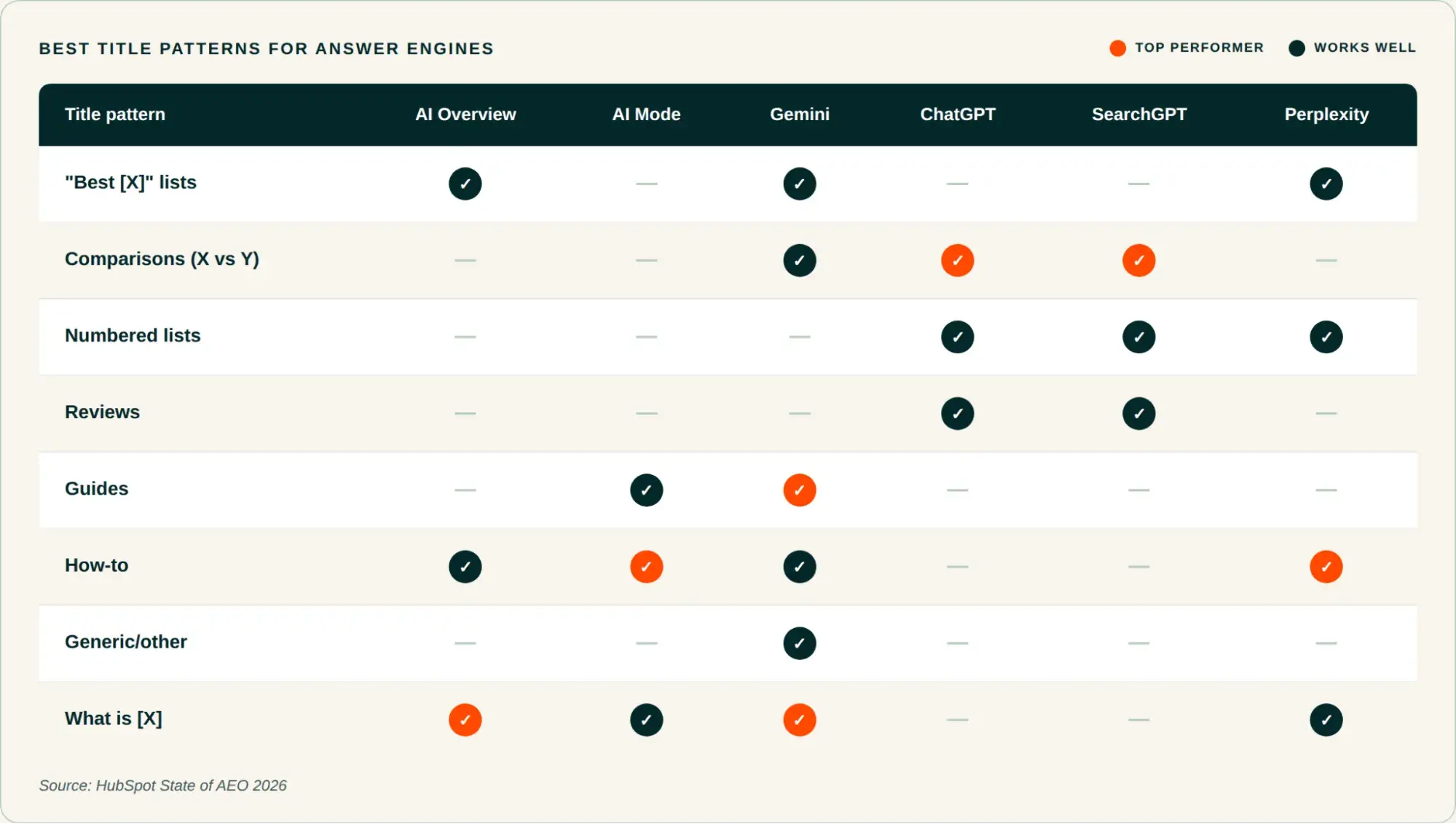
- Intent-Matched Title Patterns: Using "What is," "X vs. Y," "How to," or "Best X" titles remains the most significant factor in initial retrieval.
- Structural Signals: The inclusion of statistics, visible last-updated dates, and clear author bios acts as a trust indicator for models.
- Schema Markup: While debated, the use of
Article,HowTo,FAQPage, andItemListschemas provides the necessary metadata for engines to categorize content correctly.
The Logic of LLMs: Why These Formats Work
Why do listicles and comparison tables succeed where long-form, dense prose often fails? The answer lies in "predictable extraction."
Predictable Extraction
Research from Stanford and recent GEO-SFE (Generative Engine Optimization) preprints reveal a U-shaped accuracy curve in LLM processing. When relevant information is buried in the middle of long, unstructured paragraphs, accuracy drops. Conversely, when information is presented in lists, tables, or short, header-driven sections, extraction accuracy improves by as much as 43%. By structuring content into "chunks," publishers make it easier for AI models to lift specific, verifiable facts without misinterpreting context.
![On-page content formats answer engines actually favor [new research]](https://53.fs1.hubspotusercontent-na1.net/hubfs/53/best-on-page-content-formats-for-ai-2-20260525-5829990.webp)
Citation Signals and Authority
Models are trained to prioritize authoritative, verifiable content. A page that includes a clearly labeled "Last Updated" date signals that the content is current, while an author bio provides the "who" behind the "what." When this is paired with FAQ sections utilizing FAQPage schema, the model is presented with a perfectly packaged Q&A format that it can insert directly into a generated answer.
Practical Templates for Implementation
To capitalize on these findings, marketers should align their content production with the following intent-based templates:
1. The Informational Article (Best for "What is X?")
- Structure: Start with a high-level definition (The "TL;DR").
- Body: Use H2s for core concepts and H3s for sub-points.
- Signals: Include an FAQ section at the bottom and link to related topic clusters.
2. The Commercial Listicle (Best for "Best X Tools")
- Structure: A ranked list with clear, brand-name-focused H2s.
- Body: Include a comparison table highlighting key features, pricing, and pros/cons.
- Signals: Use
ItemListschema to help engines understand the ranking hierarchy.
3. The Comparison Post (Best for "X vs. Y")
- Structure: A side-by-side comparison table is non-negotiable.
- Body: Focus on objective criteria (price, features, ease of use).
- Signals: Use specific, data-backed statistics to validate claims.
4. The Procedural Guide (Best for "How to do X")
- Structure: Step-by-step instructions.
- Body: Use clear, sequential numbering.
- Signals: Implement
HowToschema and include high-resolution screenshots.
Implications for Future Governance
Optimizing for AI is not a one-time task; it is a cycle of maintenance. The HubSpot State of AEO 2026 report emphasizes that content freshness is a primary driver of sustained visibility.
![On-page content formats answer engines actually favor [new research]](https://53.fs1.hubspotusercontent-na1.net/hubfs/53/best-on-page-content-formats-for-ai-3-20260525-9814874.webp)
The Five-Step Audit for Legacy Content
- Identify High-Intent Pages: Focus on pages already receiving organic traffic.
- Review Titles: Ensure they match current high-performance patterns.
- Restructure for "Chunkability": Break down long paragraphs into bulleted lists or short, header-preceded sections.
- Inject Trust Signals: Add or refresh author bios and "Last Updated" timestamps.
- Implement Schema: Map existing content to the most relevant
schema.orgtypes.
Governance and Measurement
To ensure long-term success, brands must adopt a governance model where one owner is assigned to each content cluster. This owner is responsible for monitoring citation shifts and updating content whenever a competitor enters the answer space or a model update fundamentally changes how a query is answered.
Measurement should move beyond traditional traffic metrics. Marketers should track:
- Citation Frequency: How often the brand is mentioned in AI responses.
- Share of Voice: The percentage of AI-generated answers that include the brand compared to competitors.
- Prompt Success: Monitoring specific, high-value queries to see if the brand appears as a cited source.
Conclusion: The Path Forward
The transition to AEO is as significant as the shift to mobile-first indexing a decade ago. It requires a fundamental change in how we view the web: not merely as a collection of pages for human readers, but as a structured knowledge graph that AI must be able to parse, trust, and synthesize.
![On-page content formats answer engines actually favor [new research]](https://53.fs1.hubspotusercontent-na1.net/hubfs/53/best-on-page-content-formats-for-ai-4-20260525-9253081.webp)
By adopting these proven content formats—listicles, comparative analyses, and structured explainers—and reinforcing them with rigorous schema and clear authority signals, brands can position themselves not just as participants in the AI era, but as the foundational sources upon which the next generation of knowledge discovery is built. The tools to measure and optimize these efforts are available; the competitive advantage lies in the speed with which organizations can pivot their editorial strategy to meet the machine on its own terms.