The Indian digital payments ecosystem, underpinned by the Unified Payments Interface (UPI), continues to evolve at a breakneck pace. As of September 2026, the latest data released by the National Payments Corporation of India (NPCI) paints a portrait of a market in transition. While the dominant duopoly of PhonePe and Google Pay remains firmly entrenched, their collective grip on the market is witnessing a gradual, albeit marginal, erosion.
The struggle for market share among the "Big Two" is no longer just a race for volume, but a strategic exercise in navigating regulatory ceilings and the emergence of agile, specialized challengers. As the December 31, 2026, deadline for compliance with the 30% volume cap looms, the industry finds itself at a pivotal juncture.
Main Facts: The September 2026 Landscape
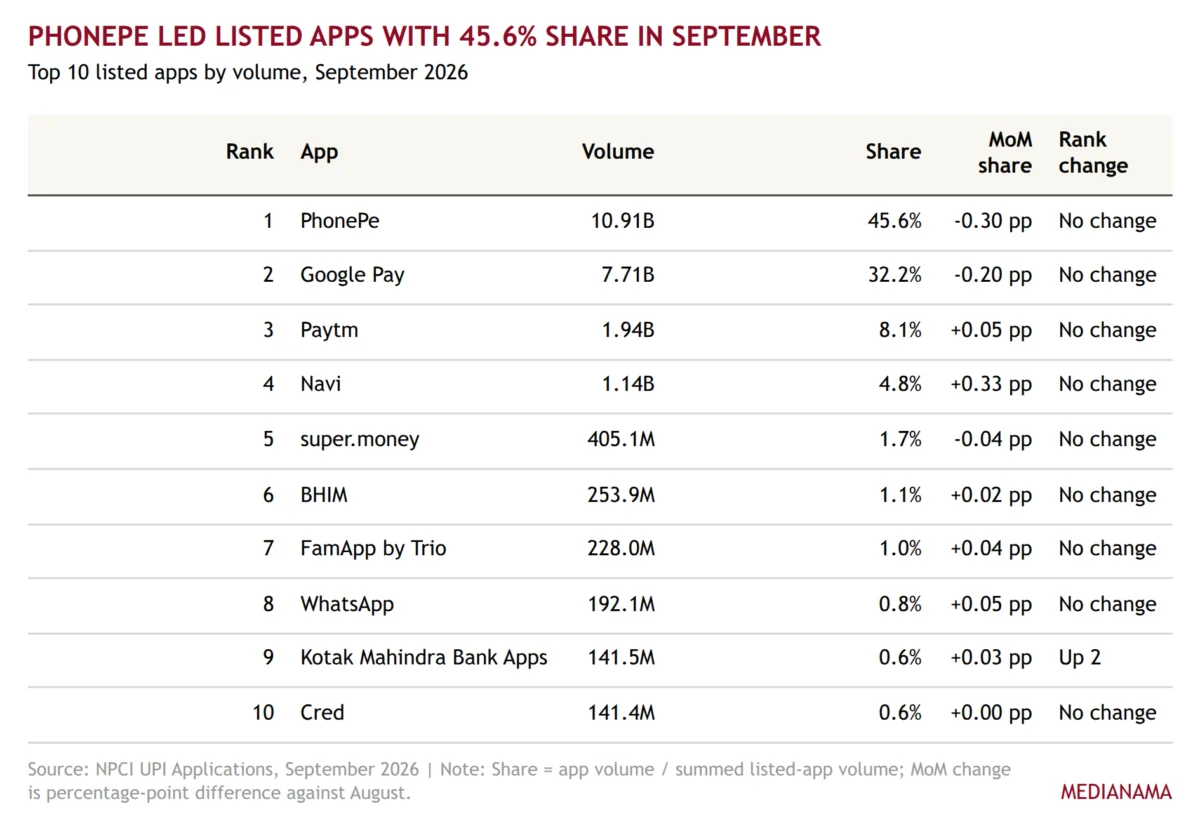
According to the NPCI’s latest UPI application statistics, the total volume of transactions processed through listed third-party apps reached 23.93 billion in September 2026. Within this ecosystem, PhonePe and Google Pay collectively accounted for 77.8% of the volume. While this figure remains staggering, it represents a notable decline from the 78.3% recorded in August 2026.
Breaking down the numbers, PhonePe solidified its position as the market leader, processing 10.91 billion transactions, which translates to a 45.57% market share. Google Pay trailed as the second-largest player, processing 7.71 billion transactions and holding a 32.23% share of the listed-app market.

The data indicates a broader trend of market diversification. Although the "Big Two" still command over three-quarters of the market, their influence is waning compared to year-ago figures. In September 2025, their combined share stood at 81.9%. Over the span of 12 months, Google Pay’s share has contracted by 3.2 percentage points (down from 35.43%), while PhonePe’s share has seen a more modest decline of 0.9 percentage points (down from 46.47%).
A Chronological Perspective: The Road to 2026
The trajectory of UPI’s growth has been marked by rapid adoption and successive policy interventions aimed at preventing market concentration.
- 2020-2021: The NPCI introduced the initial framework for the 30% volume cap, expressing concerns over the systemic risk posed by an over-reliance on a few private entities.
- 2022-2024: The deadline for compliance was repeatedly extended, reflecting the technical and operational challenges of migrating millions of users to alternative platforms without disrupting the digital economy.
- 2025: As the market matured, the "Big Two" maintained their dominance, but the entrance of new, specialized fintech players began to chip away at their peripheral margins.
- September 2026: The current data confirms that while the duopoly persists, the ecosystem is showing signs of fragmentation. Smaller players, such as Navi and super.money, are beginning to gain traction, signaling a more competitive landscape.
Supporting Data and Market Analysis
The NPCI methodology for tracking these metrics relies on a list of apps with significant transaction volumes. It is crucial to note that the NPCI clubs all UPI apps with fewer than 20,000 monthly transactions into an "Other Apps" category, which helps maintain the focus on the primary market drivers.
Performance of the Top Tier
Beyond the two leaders, the rest of the pack is showing distinct signs of life. Paytm, despite its well-documented regulatory and operational hurdles, remains the third-largest player, processing 1.94 billion transactions and holding an 8.1% share of the listed-app volume.

The fourth position is held by Navi, which has demonstrated impressive growth, processing 1.14 billion transactions in September 2026—an increase from 1.08 billion in August. The newcomer super.money has also made waves, entering the top five with 405.1 million transactions. Furthermore, the ascent of traditional banking apps, such as the Kotak Mahindra Bank suite—which rose to ninth place in September—suggests that consumers are becoming increasingly comfortable using banking-native apps alongside third-party fintech platforms.
Official Responses and Regulatory Implications
The elephant in the room remains the 30% volume cap circular. The regulation stipulates that no single Third-Party App Provider (TPAP) should process more than 30% of the total volume of UPI transactions, calculated on a rolling three-month basis.
The NPCI has extended the compliance deadline to December 31, 2026, granting PhonePe and Google Pay a final window to adjust their operational structures or encourage user migration to other platforms. However, the data for September 2026 reveals that both companies are still significantly above this 30% threshold.
Regulators argue that the cap is essential for "market equilibrium," preventing a "single point of failure" scenario that could cripple India’s digital payment infrastructure. Industry analysts, however, point out that the market’s reliance on these two apps is a reflection of superior user experience, network effects, and deep integration into the Indian retail sector. Forcing a shift, they argue, could lead to a temporary dip in transaction efficiency or user dissatisfaction.

The Broader Implications: What Lies Ahead?
The implications of these trends are far-reaching for the fintech industry, the government, and the end-user.
1. The Challenge of Compliance
For PhonePe and Google Pay, the next few months are critical. They must balance aggressive growth with the impending necessity of reducing their market share to comply with the NPCI directive. This may involve strategic changes to their reward programs, user acquisition tactics, or even a transition toward more "open-loop" ecosystems where their infrastructure supports other, smaller apps.
2. The Rise of the Challenger
The growth of apps like Navi and super.money indicates that the market is not static. If the "Big Two" are forced to limit their operations, these challengers are positioned to absorb the overflow. The focus is shifting from "acquiring new users" to "retaining existing ones" through loyalty programs, insurance cross-selling, and credit-based UPI services.
3. Strengthening the UPI Backbone
From the government’s perspective, the primary goal is the resilience of the UPI network. The diversification of market share—even at a slow pace—is viewed as a success. It ensures that if one app faces a server outage or security vulnerability, the impact on the national economy is contained.

4. The Consumer Experience
Ultimately, the end-user remains the arbiter of this market. If the regulatory cap forces users toward inferior apps, the overall utility of UPI could decline. The ongoing competition for the "third" and "fourth" spots in the market is healthy, as it encourages innovation in UI/UX, customer service, and added value, such as personal finance management tools integrated directly into the payment workflow.
Conclusion
The September 2026 data serves as a snapshot of a market in flux. We are witnessing the maturation of the UPI ecosystem, moving away from a pure duopoly toward a more nuanced, multi-player environment. While the 30% volume cap continues to loom as a major hurdle, the broader trend is one of stabilization and growth for secondary players.
As the calendar turns toward the end of 2026, all eyes will be on the NPCI to see how the enforcement of the volume cap unfolds. Will the "Big Two" find a way to comply without stifling the digital economy, or will we see a forced rebalancing that fundamentally alters how Indians pay for everything from street-side groceries to high-value online purchases? The answer to that question will define the next chapter of India’s digital financial revolution.