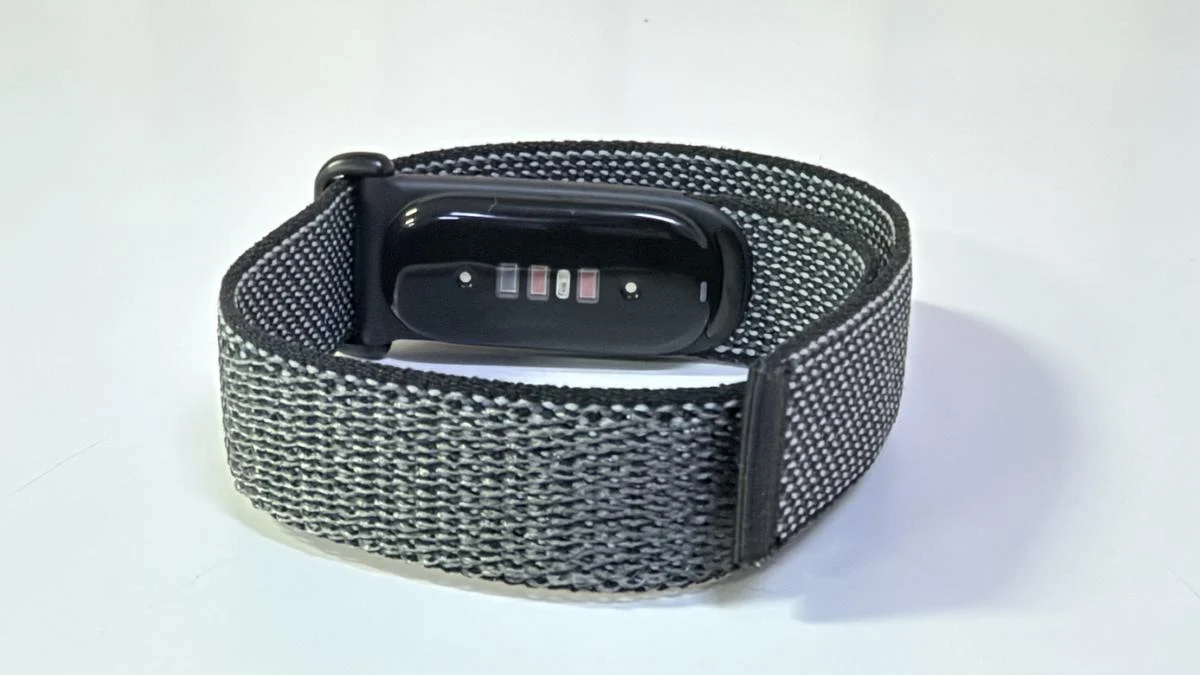
In an era where smartwatches have become increasingly bulky, demanding our attention with a relentless stream of notifications, haptic pings, and glowing OLED displays, a new movement is emerging in the wearable tech industry. It is a movement toward "ambient technology"—devices that work quietly in the background without requiring constant interaction. Leading this charge is the Google Fitbit Air.
Priced at ₹13,999 in the Indian market, the Fitbit Air represents a significant pivot for Google. It marks a return to the foundational philosophy of the original Fitbit trackers: simplicity, comfort, and data-driven insights. By stripping away the screen, Google is betting that a segment of the fitness-conscious population is suffering from "screen fatigue" and is looking for a more discreet way to monitor their health.
Main Facts: The Screenless Proposition
The Fitbit Air is not a smartwatch; it is a dedicated health sensor. Its primary objective is to bridge the gap between high-end fitness rings like the Oura and traditional wrist-based trackers. The device is built around a small, pebble-shaped tracking module that weighs a mere 5.2 grams. When paired with its woven fabric strap, the entire assembly weighs approximately 12 grams, making it one of the lightest wearables on the market.
The most striking feature—or lack thereof—is the absence of a display. There are no buttons to press and no menus to navigate. Interaction with the hardware is limited to a firm double-tap, which prompts a small status LED to glow: white for a healthy battery and red for a low charge. For everything else, the device relies on the Google Health app, creating a "set it and forget it" user experience.
Under the hood, the Fitbit Air is packed with sensors designed for 24/7 monitoring. It tracks heart rate, heart-rate variability (HRV), skin temperature variations, and movement. It is water-resistant up to 50 meters, allowing it to transition seamlessly from a morning swim to a night of deep sleep.
Chronology: From Step-Counting to AI-Powered Coaching
To understand the Fitbit Air, one must look at the evolution of the Fitbit brand under Google’s stewardship.
- The Early Era (2009–2014): Fitbit dominated the market with simple clip-on and wrist-worn devices like the Fitbit Flex. These devices focused on basic metrics: steps, distance, and estimated calories burned.
- The Smartwatch Shift (2015–2020): Following the launch of the Apple Watch, Fitbit pivoted toward "smarter" devices like the Ionic and Versa, incorporating larger screens, GPS, and third-party apps.
- The Google Acquisition (2021): Google finalized its $2.1 billion acquisition of Fitbit, sparking questions about how the brand would integrate with the Android ecosystem and Google’s own hardware, like the Pixel Watch.
- The Integration Phase (2022–2023): Google began merging Fitbit accounts into Google accounts and streamlining the software experience, while the Pixel Watch became the flagship "smart" wearable for the company.
- The Launch of Fitbit Air (2024): Recognizing that the Pixel Watch’s one-day battery life and bulky form factor weren’t for everyone, Google launched the Fitbit Air. This device fills a specific niche: a high-end, low-profile tracker for those who might already own a mechanical watch or who want a distraction-free health monitor.
Supporting Data: Performance and Metrics
The efficacy of a screenless tracker depends entirely on the quality of its data and the intuitiveness of its companion app. During extensive testing, the Fitbit Air showed consistent performance across several key pillars.
Sleep Architecture and Recovery
Sleep tracking remains the Fitbit Air’s "killer feature." Because of its lightweight, fabric-based design, it avoids the "clunkiness" of a smartwatch that often leads users to remove their devices at night. The Google Health app breaks down sleep into:
- Deep Sleep: Essential for physical recovery and immune function.
- REM Sleep: Critical for cognitive function and memory consolidation.
- Light Sleep/Restlessness: Identifying periods of wakefulness that the user might not even remember.
The device also calculates a "Readiness Score." This metric uses a combination of recent sleep patterns, HRV, and previous day’s activity to tell the user whether they should push for a high-intensity workout or focus on active recovery.
Heart Rate and Cardio Load
The Fitbit Air utilizes an optical heart rate sensor that provides continuous tracking. In comparison to chest-strap monitors, the Air remains remarkably accurate during steady-state cardio (running, cycling), though like most wrist-based optical sensors, it can lag slightly during high-intensity interval training (HIIT) where heart rate fluctuations are rapid.
A newer metric introduced here is "Cardio Load." This measures the strain placed on the cardiovascular system over time, helping athletes avoid overtraining. By comparing the last seven days of activity against a longer-term baseline, the app can alert users if they are increasing their intensity too quickly.
Battery and Charging Infrastructure
One of the primary pain points of modern wearables is "charging anxiety." The Fitbit Air addresses this with a battery life that consistently lasts seven days.
- Full Charge Time: 90 minutes.
- Fast Charging: A 5-minute charge provides roughly 24 hours of use.
- Connection: Uses a proprietary magnetic pogo-pin cable that attaches to the underside of the sensor module.
Official Responses and Strategic Positioning
Google’s official stance on the Fitbit Air emphasizes the concept of "Wellness, not Distraction." Company spokespeople have noted that while the Pixel Watch is designed for "productivity and connectivity," the Fitbit Air is designed for "longevity and insight."
The integration of Gemini-powered Google Health Coach is a cornerstone of Google’s strategy. By leveraging Large Language Models (LLMs), Google aims to move beyond "descriptive analytics" (telling you what happened) to "prescriptive analytics" (telling you what to do about it).
"We don’t want to just give users a graph of their heart rate," a Google Health representative stated during a recent product briefing. "We want Gemini to look at that graph, see that your resting heart rate has risen by five beats over three days, and suggest that you might be coming down with a cold or need more hydration."
However, this feature is currently locked behind the Google Health Premium paywall (₹499/month), a move that has met with mixed reactions from the community. While the basic tracking remains free, the most advanced AI insights require an ongoing financial commitment.
Implications: The Future of the "Invisible" Wearable
The launch of the Fitbit Air carries significant implications for the broader tech landscape.
1. The "Digital Detox" Trend
As society becomes more aware of the mental health impacts of constant connectivity, there is a growing market for "dumb" versions of smart tech. The Fitbit Air caters to this by providing all the data of a high-end smartwatch without any of the digital noise. It suggests a future where our devices are increasingly invisible, woven into our clothing or hidden in jewelry.
2. Competition with Smart Rings
The Fitbit Air is a direct shot at the smart ring market. While rings like the Oura offer a screenless experience, they are often more expensive and can be uncomfortable for certain types of weightlifting or manual labor. The Fitbit Air offers a similar "low-profile" benefit but with the reliability of a wrist-based sensor and a lower entry price point.
3. AI as the New Interface
When a device has no screen, the "interface" becomes the AI. The success of the Fitbit Air will depend on whether Google can make Gemini feel like a genuine coach rather than a generic chatbot. If the AI can successfully identify patterns—such as a user’s caffeine intake affecting their REM sleep—it justifies the screenless hardware.
4. The Data Privacy Conversation
With Google now fully integrating Fitbit data into its ecosystem, questions regarding health data privacy remain at the forefront. Google maintains that health data is not used for ad targeting, but as the AI becomes more "personal" in its coaching, the sheer volume of sensitive biological data being processed in the cloud will continue to be a point of scrutiny for regulators and privacy advocates alike.
Final Verdict
The Google Fitbit Air is a sophisticated piece of hardware that celebrates the "less is more" philosophy. For ₹13,999, it offers a level of comfort that most smartwatches cannot match, backed by one of the most robust health data ecosystems in the world.
While it may not appeal to the "gadget-head" who wants to take calls and reply to texts from their wrist, it is a compelling option for the serious athlete, the sleep-deprived professional, or the minimalist who wants to stay healthy without being tethered to a screen. It isn’t just a return to the basics; it is a refinement of what a health tracker should have been all along: a silent partner in the pursuit of wellness.