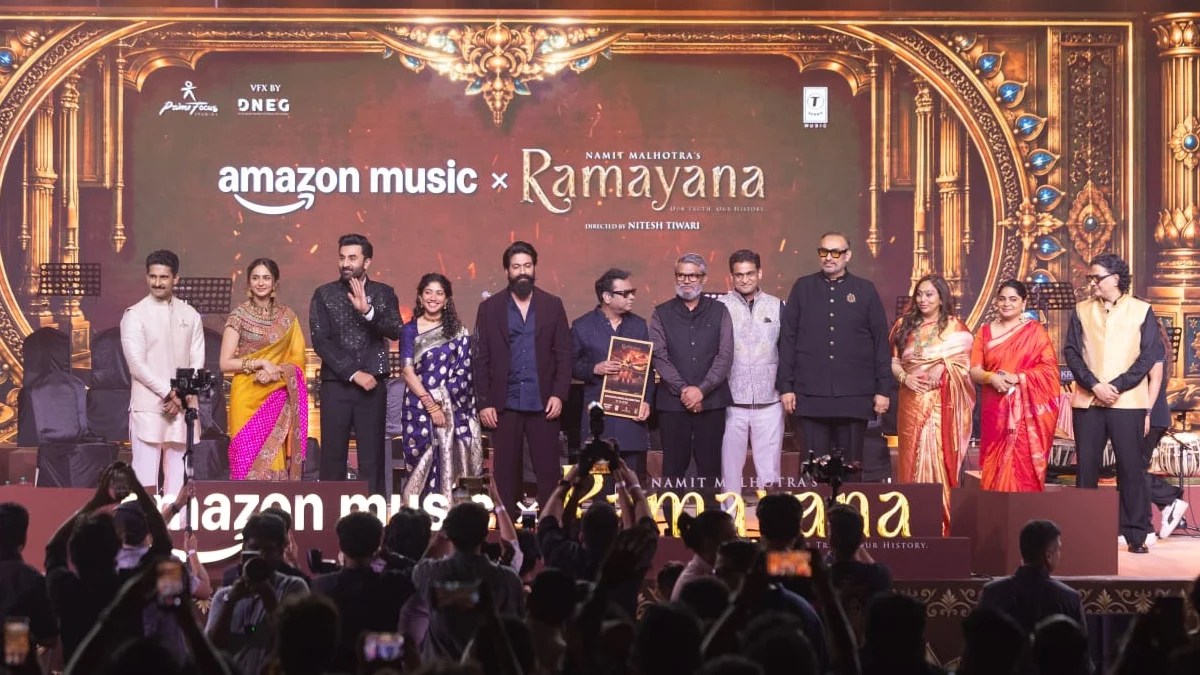
CHENNAI – The air at the Chennai Trade Centre was thick with anticipation, resonating not just with the echoes of ancient scripture but with the cutting-edge harmonies of modern cinematic brilliance. As the world counts down to the cinematic event of the decade, Amazon Music orchestrated a monumental celebration of Ramayana: Part 1, bringing together the titans of Indian cinema and the maestros of global music to unveil the soul of an epic.
Led by the legendary A.R. Rahman and attended by the film’s star-studded cast—including Ranbir Kapoor, Yash, Sai Pallavi, Ravie Dubey, and Rakul Preet Singh—the event served as a clarion call for the worldwide release of director Nitesh Tiwari’s ambitious adaptation. The evening was a masterclass in cultural synergy, marking a significant milestone in the promotional journey of a film that seeks to redefine Indian mythology for a global audience.
The Genesis of an Epic: A Musical Odyssey
The collaboration behind Ramayana is nothing short of historic. By uniting the melodic genius of two-time Oscar winner A.R. Rahman with the atmospheric, world-renowned soundscapes of eight-time Academy Award winner Hans Zimmer, producer Namit Malhotra has signaled his intent to create a sonic experience that transcends geographical boundaries. With lyrics penned by the esteemed Dr. Kumar Vishwas and the album released under the prestigious T-Series banner, the music is positioned as the heartbeat of the narrative.
The evening commenced with a poignant performance by a children’s choir, whose rendition of the Tamil version of Jai Jai Ram set a devotional and ethereal tone. It was a deliberate choice to ground the high-octane production in the humility and sanctity of the original epic. As the choir’s voices soared, it became clear that this project was not merely a film, but an exercise in cultural preservation through modern artistic expression.
Chronology of the Celebration
The event unfolded as a carefully curated narrative, mirroring the emotional arc of the Ramayana itself. Following the opening invocation, the creative forces behind the project—Namit Malhotra and director Nitesh Tiwari—took the stage to discuss the arduous journey of translating one of history’s most profound epics into a visual and auditory masterpiece. Both spoke passionately about the deep-rooted connection to the Tamil language and its historical significance in the retelling of the Rama story.
A major highlight of the night was the live interaction with A.R. Rahman and singer Chinmayi Sripaada. Their performance of Jai Jai Ram served as the emotional centerpiece of the event. Shortly thereafter, the spotlight shifted to the film’s antagonist, Ravana, portrayed by the formidable Yash. Discussing the track Ravana Tandav, which premiered during the recent Dussehra festivities, Yash articulated how the song’s dark, rhythmic intensity acted as a gateway into the aura of Lord Shiva, ultimately informing his complex and nuanced portrayal of the demon king.
The musical journey continued as Rahman, supported by his orchestra and chorus, unveiled themes from the film’s background score. Tracks such as Mangal Rang and Jodi Jodi highlighted the diversity of the album, while Sachet Tandon brought the house down with the first-ever live performance of Main Ram. The grand finale saw the entire creative team—cast, singers, and technicians—united on stage, symbolizing the collaborative spirit required to bring such a colossal vision to fruition.
Supporting Data: A Global Sonic Architecture
The technical ambition behind the Ramayana soundtrack is unprecedented. Amazon Music, serving as the official streaming partner, has optimized the release to ensure that the depth of the orchestration is accessible to every listener, whether through standard streaming or high-fidelity formats.
Technical Accessibility:
- Audio Quality: The album is available in HD and Ultra HD, with extensive support for Spatial Audio, allowing listeners to experience the surround-sound immersion intended by Zimmer and Rahman.
- Platform Reach: The music is available across all Amazon Music tiers, including the free, ad-supported service, ensuring that the epic reaches the widest possible demographic.
- Global Distribution: With T-Series handling the label duties and a multi-language rollout (Hindi, Tamil, Telugu, Kannada, and Malayalam), the project is engineered to resonate with the Indian diaspora and international audiences alike.
The film itself is a gargantuan production, backed by Prime Focus Studios, DNEG, and Monster Mind Creations. With a release scheduled for November 5, 2026, the film is set to challenge global box office standards, with an IMAX release slated to provide the ultimate immersive experience.
The Visionaries: Official Perspectives
The success of this musical endeavor lies in the convergence of diverse philosophies. Namit Malhotra, Global CEO of DNEG and the visionary producer behind the film, emphasized that music was the "foundational bedrock" of his vision.
"Bringing A.R. Rahman and Hans Zimmer together was not just about star power," Malhotra noted. "It was about creating a sound that is authentically Indian but possesses a universal language of emotion. We wanted to ensure that the music could stand alone as an epic, even before the audience sees a single frame of the film."
A.R. Rahman, reflecting on the collaborative process, described the experience as a "once-in-a-lifetime journey." He spoke of the challenge of weaving music around the specific beliefs and emotional weights associated with the Ramayana. "Working with Nitesh, Namit, and Dr. Kumar Vishwas was a process of discovery. We weren’t just writing songs; we were trying to capture the essence of a civilization," Rahman stated.
Bhushan Kumar of T-Series echoed these sentiments, highlighting the "distinct musical sensibilities" at play. By blending the melodic soul of Indian classical traditions with the cinematic tension of Western orchestral scoring, the album represents a bridge between eras.
Strategic Implications and Cultural Resonance
The choice of Chennai as the launchpad for this musical extravaganza is not coincidental. It serves as a nod to the deep-rooted cultural and artistic heritage of South India, a region that holds the Ramayana in high esteem. Rishabh Gupta, General Manager of Amazon Music India, noted that the timing—positioned strategically between Dussehra and Diwali—was designed to honor the "musical legacy of the epic" while simultaneously fueling the promotional engine for the global release.
The Roadmap Ahead:
- Part 1 (November 5, 2026): The initial installment, focusing on the early life of Lord Rama and the journey toward the conflict.
- Part 2 (Diwali 2027): The conclusion of the saga, expected to delve into the climactic battles and the moral resolution of the epic.
- International Reach: With Sony Pictures managing international distribution outside of India, the film is positioned to be one of the most widely distributed Indian productions in history.
The implications for the Indian film industry are profound. Ramayana represents a transition into a new era of "prestige blockbusters," where the audio-visual quality is prioritized as a primary product. By investing heavily in the musical score, the production team is essentially "marketing the atmosphere," ensuring that the brand is established in the public consciousness long before the film hits the screen.
Conclusion: A Legacy in the Making
As the curtains closed on the Chennai event, the feeling in the hall was one of profound anticipation. The collaboration between Rahman and Zimmer has succeeded in creating a soundscape that is at once traditional and futuristic.
For fans, the wait until November 2026 will be defined by the music currently being shared across platforms. Ramayana is no longer just a script in production; through the efforts of Amazon Music and the creative team, it has become a living, breathing auditory experience. As the world prepares for the epic to unfold on the big screen, one thing is certain: the music has already won the hearts of the audience, setting the stage for what promises to be a defining moment in modern Indian cinema.
In the words of those involved, this is not just a film release; it is a cultural reclamation, a global dialogue, and a timeless story, retold through the most powerful medium of all: sound.