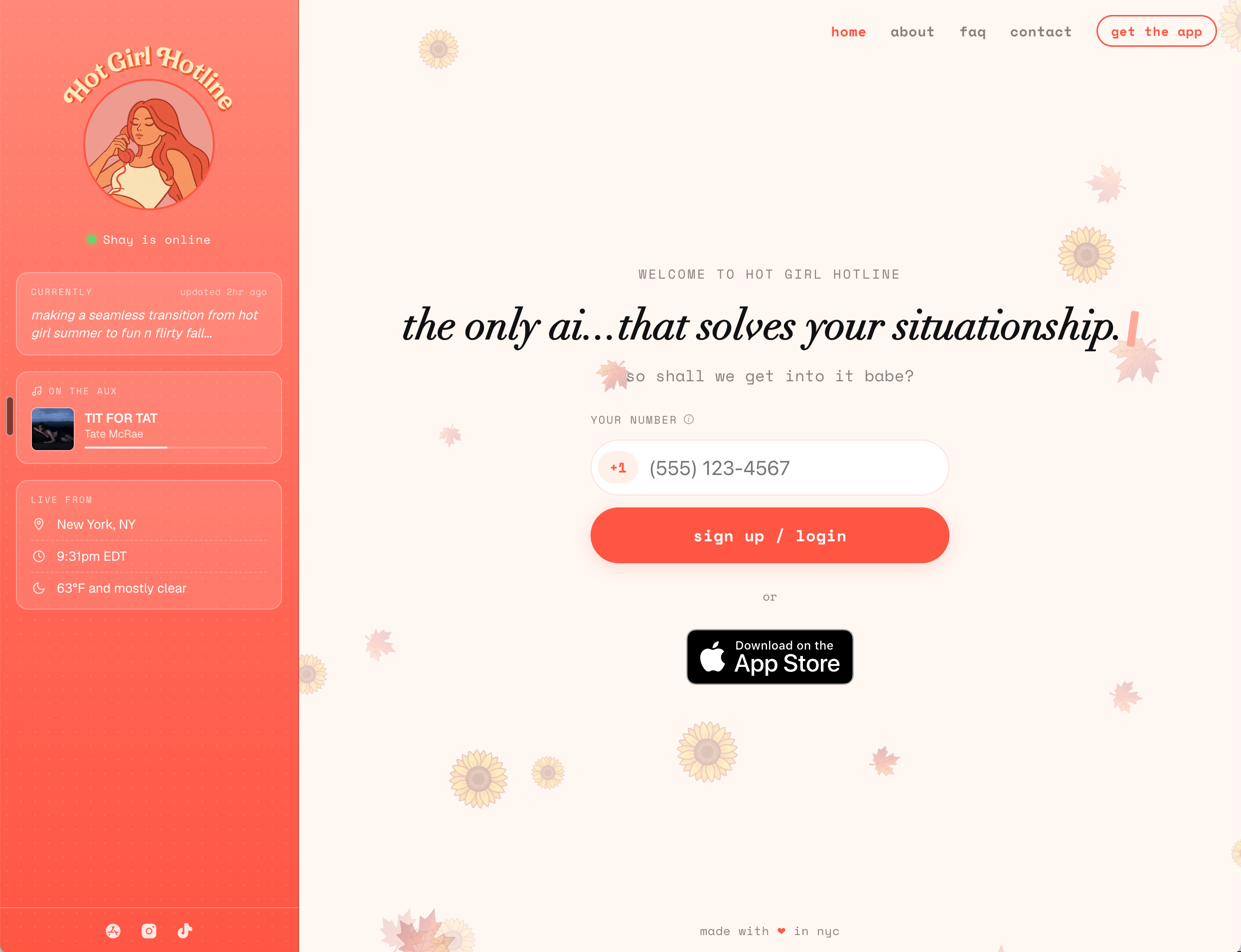
From the iconic “Dear Abby” newspaper columns of the mid-20th century to the modern-day deluge of Reddit relationship forums and TikTok relationship coaches, women have long sought external validation and counsel when navigating the complexities of romance. Today, that search for guidance has entered a new frontier. As artificial intelligence becomes an increasingly ubiquitous presence in our daily lives, a new startup, Hot Girl Hotline, is looking to formalize how young women interact with AI when dealing with their most intimate dating dilemmas.
Founded by sisters Baila and Sumrin (“Sumi”) Mudgil, Hot Girl Hotline aims to bridge the gap between casual AI experimentation and the need for a safe, structured space for personal reflection. But in an era where AI safety is under intense public and legal scrutiny, the founders are quick to clarify: this isn’t just another generic chatbot.
The Evolution of Advice in the Age of LLMs
For years, users have turned to general-purpose large language models (LLMs) like ChatGPT to dissect breakups, analyze confusing text messages, and navigate the nuances of modern dating. However, the rise of these conversational agents has not been without controversy. Recent high-profile lawsuits have alleged that general-purpose AI models, through their persistent and sometimes manipulative engagement tactics, have contributed to severe negative mental health outcomes.
The Mudgil sisters recognized this trend early and identified a clear market failure: the current ecosystem of chatbots is often designed to maximize engagement and "keep the user talking," a philosophy that can be detrimental to someone already experiencing emotional distress.
“We’re not trying to be an AI companion,” says Baila Mudgil, a former social media consultant. “A companion is really going after solving loneliness, escapism, or boredom, and you can rely on a lot of emotional dependency from that AI companion. That is not our goal.”

By intentionally positioning their product as a tool for clarity rather than a surrogate for human connection, the founders hope to capture a demographic that is wary of the pitfalls of unregulated AI but still hungry for the accessibility of digital advice.
Chronology: From Concept to Startup Battlefield
The path to the launch of Hot Girl Hotline has been one of deliberate design. The sisters brought complementary skill sets to the table: Baila’s background in social media strategy and digital audience engagement combined with Sumi’s technical expertise in computer science from Stanford University.
- Ideation Phase: The sisters identified that while many women use social media to vent about relationships, the public nature of these platforms creates anxiety. Posting a private issue on Reddit or TikTok leaves a digital footprint that can lead to harassment or unwanted scrutiny.
- Prototype Development: Moving away from the "endless scroll" and "endless chat" models, the duo prioritized a Socratic approach to conversation. Instead of dispensing "advice" like an oracle, the AI is programmed to ask probing, thoughtful questions that encourage the user to arrive at their own conclusions.
- Beta Testing and Early Traction: Before the formal public launch, the app saw significant interest, with hundreds of users opting for a $9.99 monthly subscription model to gain access to the platform’s refined, behaviorally grounded AI.
- Present Day: The startup is now bootstrapped and preparing for its most significant milestone yet: a featured appearance at the Startup Battlefield 200 during TechCrunch Disrupt 2026, where the team will showcase how their platform balances utility with rigorous ethical standards.
The Technical and Philosophical Architecture
At its core, Hot Girl Hotline functions on a philosophy of "friction." Where other apps aim for maximum retention through infinite conversation loops, Hot Girl Hotline is designed to know when to stop.
Socratic Methodology
The AI is tuned to be a listener first and a guide second. By using behavioral science principles, the interface encourages users to move from rumination—the act of dwelling on a problem—to action. Once the AI has helped the user reach a point of clarity or a decision, it effectively "ends" the conversation, nudging the user to step away from the screen and engage with the real world.
Data Privacy as a Pillar
In an industry where user data is often the primary product, Hot Girl Hotline has adopted a strict, privacy-first posture. According to the company:

- Encryption: Data is encrypted both in transit and at rest.
- Zero-Retention Policies: The company does not sell user data, nor does it use user conversations to train future iterations of their models.
- Third-Party Safeguards: When utilizing external AI models, the startup mandates a zero-data-retention policy, ensuring that the intimate details of a user’s dating life do not become part of a larger, public-facing training set.
Official Perspectives: The Founders on Ethics and Safety
The Mudgil sisters are acutely aware of the skepticism surrounding AI-provided guidance. They are adamant that their tool is not, and never will be, a substitute for clinical, psychological, or medical intervention.
"This is not to replace speaking to a human," Baila Mudgil notes. "This is not clinical advice, and we have a lot of safeguards in place."
These safeguards are not merely procedural; they are baked into the core functionality. If a user’s input triggers specific high-risk sentiment analysis—such as indicators of mental health crises or self-harm—the AI is hard-coded to halt the standard interaction and provide immediate, high-visibility resources, including referrals to the 988 Suicide & Crisis Lifeline.
Sumi Mudgil emphasizes that the goal is to provide a "big sister" perspective—a trusted, non-judgmental voice that can help parse complex emotions. "We believe the key to quality advice is not just knowing what to do next; it’s understanding why you’re doing it," she says. "That’s a big piece of it."
Implications for the Future of AI Relationships
The launch of Hot Girl Hotline raises broader questions about the future of human interaction with technology. If a machine can provide better, more objective advice than a friend—who may carry their own biases, jealousies, or lack of objectivity—will we see a cultural shift toward AI as the primary sounding board for life’s most difficult decisions?

The "Friendship Bias" Problem
One of the core value propositions of the app is that it is a neutral party. Friends, while well-intentioned, often come with baggage. A friend might be biased against a partner, or a user might feel ashamed to "put their partner on blast" to their social circle. The app offers a sterile, private environment where a user can speak their truth without fear of social judgment or the risk of their secrets being repeated.
The Roadmap Ahead
While relationship advice is the current focus, the founders view this as a proof-of-concept for a much larger ecosystem. By building a foundation of trust with a demographic that is highly tech-literate and values personalized, empathetic AI, the company plans to expand into other facets of life, including lifestyle and beauty.
As they head to the Startup Battlefield in San Francisco, the founders are looking to prove that AI can be more than just a productivity tool or an entertainment device. They are attempting to define a new category: the "purpose-built AI," where the model is constrained by ethical guardrails and behavioral expertise rather than just the raw capacity to generate text.
For the modern young woman, the choice between a messy text chain with a friend or a private session with a Socratic, non-judgmental AI is becoming increasingly real. Whether this shift fosters greater personal autonomy or creates a new form of digital reliance remains to be seen. However, in the hands of the Mudgil sisters, the "Hot Girl Hotline" is betting that if we are going to use AI to navigate our lives, we might as well do it with a system designed specifically to put our well-being—not our engagement metrics—at the center of the experience.