
A seemingly attractive proposition of doubling your investment for retirement is being scrutinized by financial experts, who urge investors to look beyond the surface and understand the true cost of guaranteed returns.
In the quest for a secure and comfortable retirement, many salaried individuals in their early to mid-forties are drawn to financial products that promise a clear path to financial freedom. The allure of a plan where one invests a fixed sum annually for a defined period and receives a larger sum back for an extended duration is undeniably potent. Often marketed with slogans like "Pay Rs 1 lakh annually for 15 years, get Rs 2 lakh annually for the next 15 years," these retirement-focused products appear to offer a straightforward solution to the perennial concern of dwindling income versus persistent expenses post-retirement. However, beneath this enticing veneer lies a complex financial instrument that warrants a deeper, more critical examination.
While the simplicity and guaranteed nature of these plans are their primary selling points, a closer look at the underlying mechanics, particularly the internal rate of return (IRR) and the impact of deferment periods, reveals a more nuanced picture. Financial planners are now advising individuals to dissect these offerings meticulously, understanding not just the promised payout but also the effective cost and long-term implications for their overall financial health.
The Allure of Certainty: What Makes These Products Attractive?
The primary draw of these retirement-focused financial products lies in their inherent simplicity and predictability. Unlike market-linked investments, which are subject to the vagaries of economic fluctuations, these plans offer a tangible guarantee.
Key Advantages:
- Simplicity and Transparency: These products are often designed to be easily understood, eschewing complex financial jargon. Investors are presented with clear figures regarding premiums, payout amounts, and durations, fostering a sense of clarity and control.
- Guaranteed Returns: The cornerstone of their appeal is the assurance of a fixed return, irrespective of market performance. This eliminates the risk associated with investment volatility, providing a sense of security, especially for those nearing retirement.
- Predictable Income Stream: Knowing precisely how much income will be available during retirement allows for better financial planning and budgeting, reducing anxiety about future expenses.
- Embedded Life Insurance Cover: Many of these plans include a life insurance component, offering a dual benefit of savings and protection. This can be particularly appealing for individuals seeking to consolidate their financial planning needs.
- Locked-in Interest Rates: In an environment where future interest rates are uncertain, locking in a guaranteed rate for retirement income can be seen as a prudent move, safeguarding against potential dips in future returns from conventional options like fixed deposits.
The appeal of knowing exactly what one is getting into, with all the terms and conditions laid out, cannot be understated. Even with the inclusion of what might seem like complex "guaranteed additions" with fancy nomenclature, the ultimate payout and its timing can typically be calculated. This clarity empowers investors to make informed decisions based on concrete figures, rather than speculative projections.
The Hidden Costs: Where the Problems Lie
Despite the apparent benefits, a significant concern with these products is the potential for investors to overestimate their value. The focus on headline figures – doubling the investment, for instance – can sometimes overshadow a more crucial analysis of the actual net returns.
The Critical Calculation: Net Return and IRR
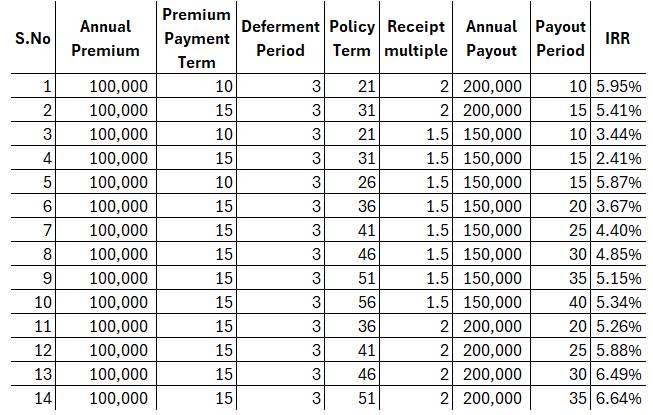
To truly assess the efficacy of these plans, it is imperative to calculate the net return, often expressed as the Internal Rate of Return (IRR). This metric accounts for the time value of money, factoring in when premiums are paid and when payouts are received. Spreadsheet software like Microsoft Excel can be instrumental in performing these calculations.

The Impact of Deferment and Premium Payment Terms:
A deeper dive into the IRR reveals a crucial insight: the longer the premium payment term and the deferment period (the gap between the last premium payment and the first payout), the lower the net returns from the product. Insurance companies often leverage this "play" on the time value of money.
Consider a scenario: an annual premium of Rs 1 lakh for 10 years, with an annual payout of Rs 2 lakh for the next 10 years. If the deferment period is extended, the effective return diminishes significantly. For instance, a longer deferment period means the investor’s capital is locked in for a longer duration without generating returns, while the insurance company benefits from the time value of that capital.
The "Magic" of the Deferment Period:
The deferment period, the time between the last premium payment and the first receipt of benefits, is often a point of subtle manipulation. Brochures might state a payout starting from the 12th year after paying premiums for 10 years. However, premiums are typically paid at the beginning of the year, while the "12th year" in insurance parlance often refers to the end of that year. This effectively means the first payout might only be received at the start of the 13th year, creating a three-year gap rather than the seemingly implied two years. This deliberate structuring, while legal, can significantly impact the investor’s realized returns.
The Challenge of Exits:
A further challenge with many traditional insurance plans, including these retirement-focused ones, is their inherent illiquidity. They are designed as long-term commitments. Should an investor’s circumstances change, or their financial needs evolve, exiting these plans prematurely often incurs substantial penalties, making them inflexible instruments in a dynamic financial landscape.
What Should Investors Do? A Balanced Approach
The decision to invest in such products is not a simple yes or no. It requires a nuanced understanding of one’s personal financial goals and risk appetite.
Strategic Integration, Not Sole Reliance:
Financial experts suggest that while these products might not offer the highest returns, they can serve a specific purpose within a diversified retirement portfolio. If the primary goal is peace of mind and securing a portion of essential retirement expenses, these guaranteed plans can be considered, provided they are not the sole component of the retirement strategy.
Key Considerations for Investors:
- Understand the Numbers: Before investing, meticulously calculate the IRR and understand how different parameters like premium payment term, deferment period, and payout duration affect the net returns.
- Factor in Inflation: The guaranteed payout, while fixed, needs to be assessed against the backdrop of inflation. A Rs 2 lakh annual payout today will have significantly less purchasing power in 15-20 years.
- Diversify Beyond Guarantees: For other retirement expenses that require growth potential, investors should explore avenues beyond guaranteed return products.
- Assess the Fit: Does this product align with your overall financial plan? Does it address a specific need that other instruments cannot?
- Peace of Mind vs. Optimal Returns: Acknowledge that sometimes a slightly sub-optimal financial solution can be acceptable if it provides significant psychological comfort and reduces anxiety about the future.
Annuity Plans: A Point of Comparison
It is crucial to differentiate these retirement-focused products from traditional annuity plans. Both are typically non-participating life insurance plans.
Annuity Plans:
- Longevity Risk Transfer: In annuity plans, the insurance company assumes the longevity risk, meaning they guarantee income for the annuitant’s entire life, regardless of how long they live.
- Taxation: Income from annuity plans is generally taxable at the individual’s marginal income tax rate.
Retirement-Focused Products (as discussed):
- Limited Payout Period: Unlike annuities, these plans offer payouts for a fixed, predetermined period. The insurance company does not bear the longevity risk.
- Tax Benefits: A significant advantage is that income from these plans can be tax-exempt, subject to certain conditions. These typically include the total cumulative annual premium for all traditional (non-linked) plans not exceeding Rs 5 lakh, and the life cover being at least 10 times the annual premium. This tax benefit is a direct consequence of their classification as life insurance plans, where the death benefit meets the 10x premium criteria. Annuity plans, lacking this death benefit structure, do not qualify for such tax exemptions on their payout income.
While annuity plans offer a more comprehensive solution for lifelong income by absorbing longevity risk, their taxable nature makes them less attractive from a net income perspective compared to the tax-exempt payouts of these specific retirement-focused insurance products, provided the tax conditions are met.
Conclusion: Informed Decisions for a Secure Future
The promise of doubling one’s investment for retirement is a powerful marketing tool. However, a prudent investor must look beyond the headline figures and delve into the underlying mechanics. By understanding the impact of deferment periods, calculating net returns, and considering inflation, individuals can make a more informed decision.
These retirement-focused insurance products can indeed play a role in a well-structured retirement plan, offering a degree of certainty and peace of mind. However, they should not be the sole pillar of one’s retirement savings. A diversified approach, incorporating products with growth potential for long-term needs and guaranteed options for essential expenses, is likely to yield a more robust and secure financial future. Ultimately, the key lies in understanding what you are buying, how it adds value to your overall financial plan, and ensuring that the peace of mind it offers is not at the expense of genuine financial security.