The digital landscape is undergoing its most significant transformation since the inception of the search engine. As generative AI and large language models (LLMs) redefine how users interact with the internet, the traditional "blue link" search experience is being superseded by direct, synthesized answers. This shift has birthed a new imperative for marketing agencies: Answer Engine Optimization (AEO).
For agencies, the challenge is no longer just about ranking for keywords; it is about securing citations and visibility within AI-driven interfaces. As clients witness competitors appearing in AI summaries, the pressure to adapt has reached a tipping point. However, scaling AEO across a diverse portfolio of clients requires more than just a new strategy—it demands a fundamental overhaul of agency infrastructure.
The Paradigm Shift: From SEO to AEO
For decades, Search Engine Optimization (SEO) was the undisputed cornerstone of digital marketing. The methodology was clear: target high-volume keywords, optimize meta-tags, build backlinks, and climb the SERP (Search Engine Results Page). Today, that landscape is fragmented. Platforms like ChatGPT, Perplexity, and Google’s AI Overviews provide users with comprehensive answers rather than lists of websites.
The Core Problem: Manual Management vs. Scalability
Many agencies are currently treating AEO as a manual, bespoke service. When managing ten or twenty clients, each with unique product lines, target demographics, and competitive sets, the manual tracking of AI citations and visibility scores becomes a logistical nightmare.

"Tool sprawl"—the practice of using disjointed, disconnected software to track brand mentions, sentiment, and visibility—is the primary bottleneck. When teams spend the majority of their time "data-wrangling" across multiple dashboards, they lose the capacity for high-level strategic thinking. To survive and thrive, agencies must transition from reactive, one-off projects to a repeatable, scalable infrastructure.
Chronology of the AEO Evolution
- 2022-2023: The Awareness Phase: Agencies began noticing shifts in organic traffic patterns as early adopters of generative AI tools started bypassing traditional search.
- Early 2024: The Competitive Pressure Point: As AI-integrated search became standard, clients began to notice competitors appearing in LLM-generated summaries. The inquiry "Why aren’t we showing up in AI results?" became a standard client-side request.
- Late 2024 – Present: The Standardization Phase: Market leaders began moving away from manual tracking, seeking consolidated platforms—like HubSpot’s AEO suite—to centralize data. This marks the current era, where AEO is moving from a "novelty" to a standard contractual deliverable for performance marketing agencies.
Supporting Data: The Case for Scalable AEO
The transition to AEO is not merely a defensive measure; it is a growth engine. Data indicates that businesses that successfully optimize for answer engines see tangible bottom-line results.
According to internal data from HubSpot, users who implement robust AEO strategies generate 2.6x more leads compared to those who rely solely on traditional search methodologies. This massive disparity highlights that AI visibility is not just about brand awareness; it is about capturing high-intent traffic at the precise moment a user is evaluating a vendor.
Key Metrics for Success
Agencies must move away from "vanity metrics" and focus on three core pillars of AEO performance:

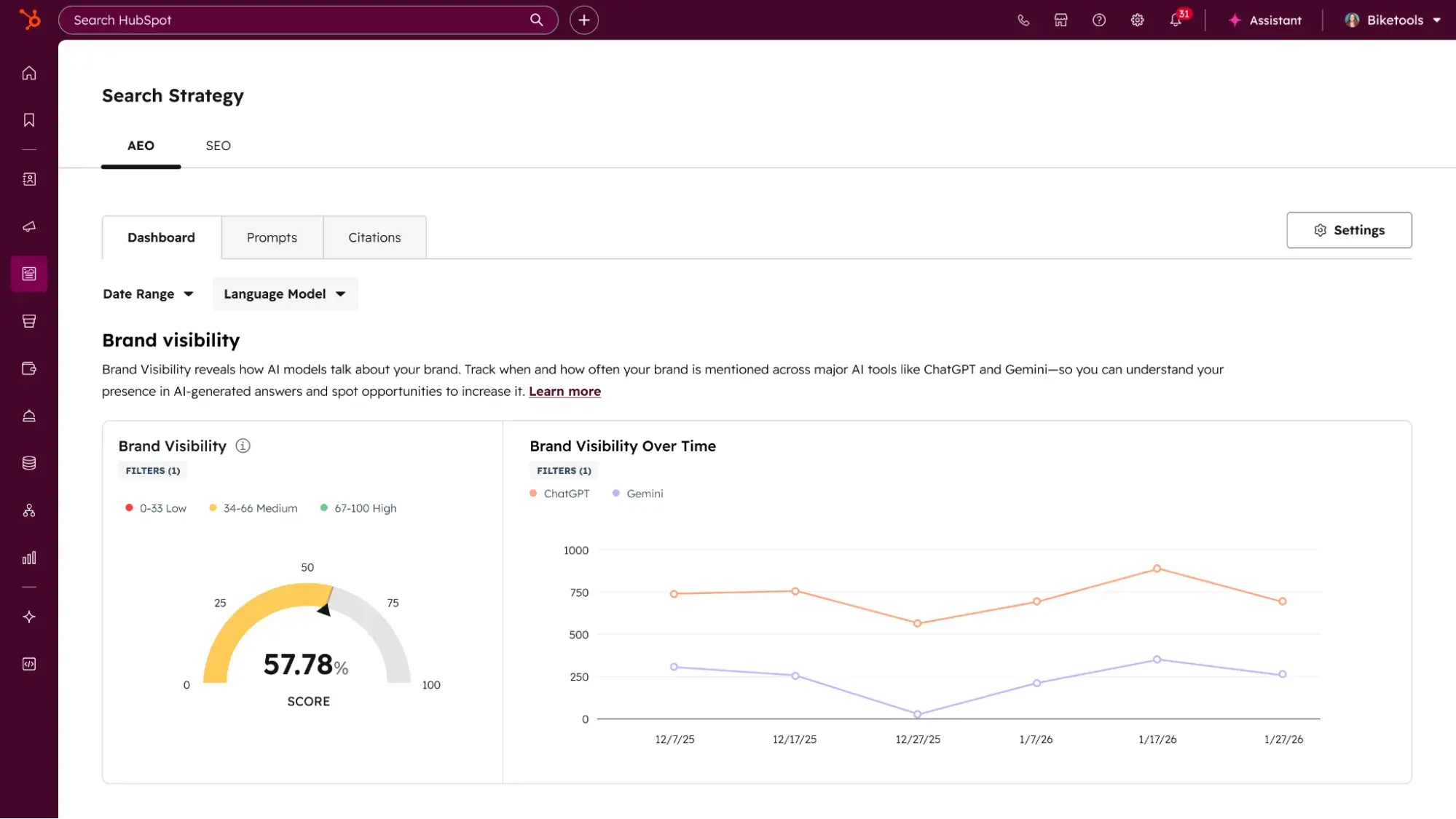
- Brand Visibility Score: A quantitative measure of how often a brand is mentioned in relation to specific industry queries.
- Share of Voice (SOV) in AI Summaries: Measuring the percentage of time a brand is cited compared to direct competitors within AI-generated responses.
- Citation Frequency: Tracking the reliability and recurrence of the brand being cited as a source of truth by AI models.
Official Industry Perspectives: The Need for Infrastructure
The consensus among industry leaders is clear: manual labor is the enemy of growth. When an agency attempts to scale AEO without a centralized platform, the inconsistency of reporting often leads to client attrition.
"Agencies that build AEO infrastructure now can make AEO part of their ongoing client services instead of treating every engagement as a one-off project," industry analysts note. By centralizing data in a tool like the HubSpot Brand Visibility Dashboard, agencies can effectively track performance, compare competitive gaps, and justify their retainers with concrete data.
Strategic Implications: How Agencies Can Adapt
To integrate AEO into a sustainable service model, agencies should follow a three-pronged structural approach:
1. Unified Monitoring
Agencies must eliminate the fragmented dashboard model. By using a single source of truth, teams can spot trends instantly. If a client’s share of voice drops, the agency needs to know if it was due to a competitor’s new content or a shift in the AI’s underlying logic. A unified dashboard allows for proactive adjustments rather than reactive explanations at the end of the month.

2. AI-Optimized Content Creation
The content that wins in AI summaries is fundamentally different from traditional SEO content. While standard SEO often favors length and keyword density, AEO favors structure, authority, and conciseness.
Agencies need to adopt a "structured-first" content framework:
- Identify Gaps: Use automated recommendations to find queries where the client should be cited but isn’t.
- Direct Answers: Craft content that explicitly answers the "who, what, and why" of a user’s query in a format that LLMs find easy to parse.
- Authority Building: Focus on high-quality citations and authoritative backlinks, which continue to act as "trust signals" for AI models.
3. Automated Reporting
Clients do not want to see raw, uninterpreted data; they want to see progress. The ability to export clear, visual reports showing the trajectory of brand visibility is critical. By automating these reports, agencies can spend their time in client meetings discussing strategy and roadmap adjustments rather than explaining the mechanics of how the data was gathered.
The Future of the Agency-Client Relationship
As we look toward the future, the agencies that define their value proposition through "AI Visibility" will hold a distinct advantage over those clinging to legacy SEO models. The market is shifting toward a model where the brand that provides the most useful, accurate information—in the format the machine prefers—wins the conversion.

The transition to AEO is not a temporary trend; it is a fundamental shift in the way information is indexed and distributed. Agencies that treat AEO as an infrastructure challenge rather than a content challenge will be the ones that survive the disruption.
Final Thoughts
For agencies, the path forward is defined by scalability. Clients are already asking for AEO. The question for agency leadership is no longer "if" they should offer it, but "how" they can build the systems to deliver it profitably. By investing in centralized tools, adopting new content frameworks, and prioritizing AI-centric reporting, agencies can turn a complex technological challenge into a competitive differentiator.
The infrastructure to deliver AEO efficiently is what separates a reactive, struggling firm from a scalable, forward-thinking agency. As the AI era matures, those who have built the systems to capture AI visibility will be the architects of their clients’ digital success.