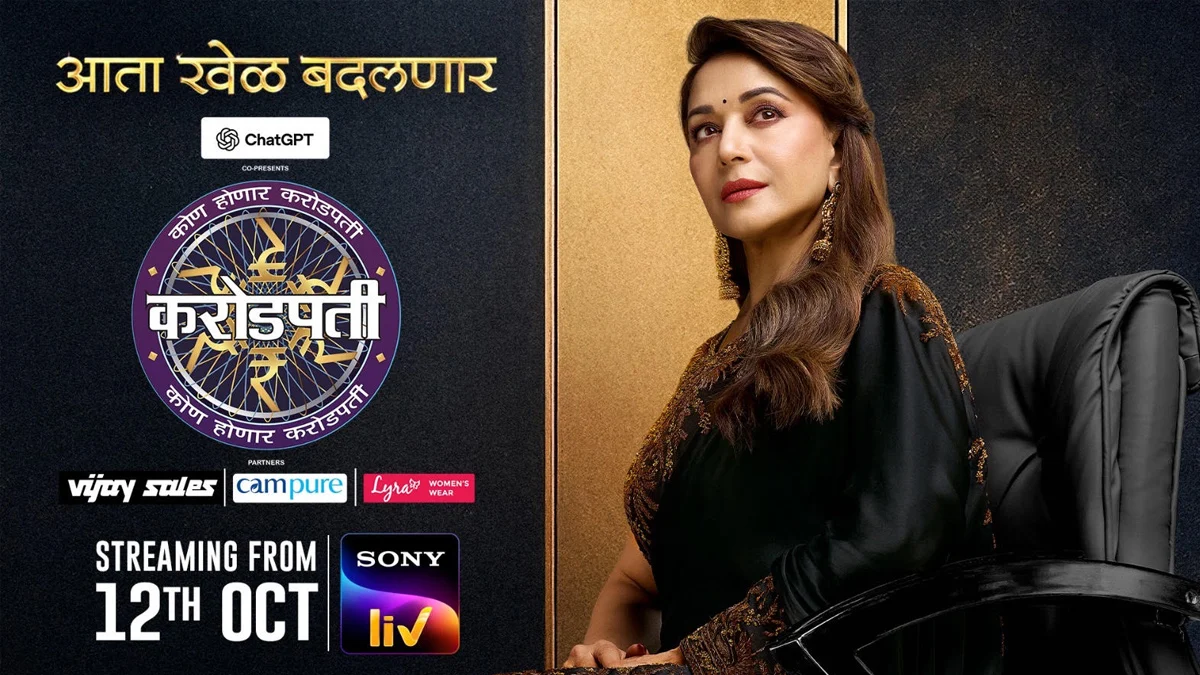
Mumbai — In a strategic maneuver that bridges the gap between traditional regional television and the frontiers of artificial intelligence, the Marathi adaptation of the global phenomenon Who Wants to Be a Millionaire?—known as Kon Honar Crorepati—is set to redefine the landscape of Indian regional broadcasting. As the show prepares for its highly anticipated return on October 12, it brings with it a fusion of Bollywood royalty and Silicon Valley innovation, signaling a pivotal shift in how advertisers and platforms approach the burgeoning Marathi-speaking demographic.
With the legendary actor Madhuri Dixit Nene taking the helm as the host, the show is not merely returning as a television program; it is re-emerging as a powerhouse of cultural and commercial synergy.
The Main Facts: A New Chapter for a Legacy Format
Kon Honar Crorepati has long been a staple of Marathi television, providing a platform for ordinary citizens to test their intellect against the backdrop of life-changing prize money. However, the upcoming season represents a departure from standard quiz show formats. By securing a high-profile partnership with OpenAI’s ChatGPT, Sony Pictures Networks India (SPNI) is attempting to integrate generative AI into the fabric of regional entertainment.
The show is scheduled to premiere on October 12 at 9:00 PM on both Sony Marathi and the streaming platform Sony LIV. Beyond the host and the technology, the show’s commercial profile has been bolstered by a diverse cohort of brand partners, including Vijay Sales, Campure, and Lyra. This collection of sponsors reflects a sophisticated advertising strategy aimed at capturing the attention of a wide demographic—from technology enthusiasts to household consumers.
Chronology: From Concept to Cultural Phenomenon
The journey of Kon Honar Crorepati mirrors the broader evolution of the Indian television industry. Since its inception, the format has consistently ranked among the most-watched shows in the Marathi market, leveraging the emotional resonance of the "common man’s dream."
- Pre-production Phase: Early 2024 saw the conceptualization of a "revamped" edition of the show. The goal was to move beyond the traditional host model and infuse the program with a fresh, contemporary energy.
- The Dixit Signing: The announcement of Madhuri Dixit as the host sent ripples through the media landscape. Known for her grace and mass appeal, her inclusion is a calculated move to capture a pan-generational audience, ranging from those who grew up watching her iconic films to the younger generation discovering her through her digital presence.
- The AI Integration: In the months leading up to the launch, SPNI and OpenAI engaged in high-level discussions regarding the role of AI in the show. The result was the creation of the "Vichaar Saathi" (Thought Companion) concept, a non-intrusive, supportive AI role designed to mirror the show’s ethos of human curiosity.
- The Ad Sales Push: September saw an aggressive onboarding of brand partners, culminating in the current line-up that positions the show as a premium advertising vehicle for the regional market.
Supporting Data: The Economics of Regional Expansion
The decision to anchor the show with a marquee name and advanced technology is backed by significant market data. According to industry reports, the Marathi regional market is one of the most vibrant and high-consuming segments in India. Advertising spend in regional markets has seen a steady uptick, as global brands shift focus from "pan-India" monolithic campaigns to hyper-localized, culturally relevant storytelling.
For Sony LIV, the digital platform serves as the primary engine for this growth. With internet penetration in Maharashtra—the wealthiest state in India by GDP—reaching new heights, the hybrid model of broadcast and OTT (Over-the-Top) streaming allows for a dual-revenue stream. The integration of ChatGPT also offers a case study in "native advertising." Unlike traditional commercial breaks, the AI integration is woven into the narrative of the show, potentially increasing brand recall and viewer engagement metrics by orders of magnitude compared to standard television spots.
Official Responses: Aligning Innovation with Tradition
The leadership teams at both Sony and OpenAI have been vocal about the strategic necessity of this collaboration.
Ranjana Mangla, head of digital ad sales and YouTube business at Sony Pictures Networks India, emphasized that this move is part of a broader, long-term regional roadmap. "As we embark on an ambitious regional expansion journey, Kon Honar Crorepati marks a significant milestone in scaling our regional entertainment proposition," Mangla stated. "Building on the iconic legacy of Kaun Banega Crorepati, we are launching the Marathi edition on a grand scale with the legendary Madhuri Dixit as the host. This is a powerful beginning to our regional growth journey, and we look forward to welcoming more brand partners to be part of this exciting season."
From the perspective of OpenAI, the partnership represents a calculated effort to democratize access to AI in India. Sheeladitya Mohanty, head of marketing for India at OpenAI, articulated the company’s vision: "Building meaningful access to AI in India requires an understanding of the languages and cultural contexts that shape how people learn, think, and engage."
Mohanty highlighted the specific role of the AI as a "Vichaar Saathi." He noted, "What we’re integrating with Sony’s Kon Honar Crorepati places ChatGPT within that context, with Vichaar Saathi giving expression to its role as an aid that extends people’s knowledge while preserving their judgement. Building this for Marathi audiences brings this ambition into a familiar setting, connecting AI’s capabilities with curiosity and aspirations."
Implications: The Future of "Smart" Television
The implications of this partnership extend far beyond a single season of a quiz show.
1. The Normalization of AI
By placing ChatGPT in the role of a "companion" rather than a "competitor," the show is actively managing the societal anxiety surrounding artificial intelligence. It presents AI as a tool for knowledge enrichment, which aligns perfectly with the ethos of a quiz show. If successful, this could set a template for how other educational and entertainment formats in India adopt generative AI.
2. Regionalization as a Growth Engine
For advertisers, the move underscores a growing reality: the most effective way to reach the Indian consumer is through their native language and cultural touchstones. By pairing a global AI brand like ChatGPT with a regional television icon, Sony is proving that regional content can attract the same caliber of brand investment as national or global programming.
3. The Evolution of Host-Centric Entertainment
The presence of Madhuri Dixit marks a shift toward "personality-driven" broadcasting in the regional space. While the quiz format is the skeleton, the personality of the host is the heart. The network is betting that Dixit’s ability to connect with contestants—to celebrate their triumphs and empathize with their struggles—will create a "sticky" viewing experience that is difficult for competitors to replicate.
4. A New Advertising Paradigm
The integration of brands like Vijay Sales, Campure, and Lyra alongside a technology partner like ChatGPT indicates a multi-layered advertising strategy. It suggests that brands are no longer satisfied with mere logo placement; they are seeking "contextual integration." Whether it is a kitchen appliance brand showcased during a question or an AI tool assisting in the pursuit of knowledge, the focus is on utility and relevance.
Conclusion: A Meeting Point for Innovation
As the countdown to October 12 begins, the television industry is watching closely. Kon Honar Crorepati is attempting to achieve what few shows have done: balancing the nostalgia of a legacy format with the disruptive potential of modern technology.
By grounding AI in a "familiar setting," as Mohanty put it, the show is bridging a generational and technological divide. It is inviting the Marathi audience to participate in the global conversation about artificial intelligence, not as passive observers, but as active users within their own linguistic ecosystem.
Whether this becomes the gold standard for regional television remains to be seen, but one thing is certain: when the lights go up on the Kon Honar Crorepati stage, it will be a showcase of how India’s entertainment industry is evolving—becoming smarter, more localized, and more technologically integrated than ever before. The show is no longer just a quest for a crore; it is a quest to define the future of Indian regional media.