By Digital News Desk
Updated: April 20, 2026
Main Facts: The Hidden Crisis of the Affluent Retiree
For decades, the narrative of retirement planning in India has been dominated by a singular, looming fear: the fear of not having enough. Financial advisors, calculators, and media headlines have focused almost exclusively on the "retirement gap," urging citizens to save more, invest earlier, and sacrifice present comforts for a secure future. However, as a generation of professionals who entered the workforce during the post-liberalization boom of the 1990s reaches the age of 60, a new, counter-intuitive problem is emerging.
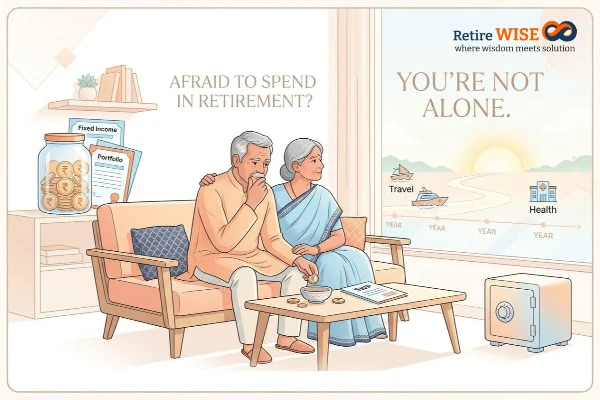
Experts call it the "Paradox of Plenty." It is a phenomenon where retirees, who have successfully built a substantial corpus through thirty years of disciplined investing, find themselves psychologically incapable of spending it.
"The goal is not more money. The goal is living life on your terms," says Chris Brogan, a sentiment that is increasingly becoming the focal point of modern financial therapy. In the Indian context, where the ethos of frugality is deeply embedded in the cultural DNA, the transition from an "accumulator" to a "spender" is proving to be more difficult than the act of saving itself.
The core of the issue lies in a binary problem set. The first problem is mathematical: not having enough money. This is well-documented. The second problem is behavioral: having enough but not knowing it—or, more accurately, not feeling it. For many senior professionals in India, the same discipline that built their wealth has now become a cage, preventing them from enjoying the fruits of their lifelong labor.
Chronology: From the Era of Scarcity to the Age of Accumulation
To understand why a 65-year-old with a ₹5 crore corpus is hesitant to book a business-class ticket or upgrade their home, one must look at the chronology of their financial life.
The 1990s: The Foundation of Scarcity
Most of today’s retirees began their careers in an era of limited choices. The early 1990s in India were marked by the tail-end of a closed economy. Scarcity was a lived reality. This generation witnessed the volatility of the markets, the high-interest rates of the late 90s, and the tech bubble burst. Their financial identity was forged in the fires of "saving for a rainy day."
2000–2020: The Discipline Phase
Over the next two decades, this cohort became the vanguard of the Systematic Investment Plan (SIP) revolution. They stayed invested through the Global Financial Crisis of 2008 and the COVID-19 pandemic of 2020. They sacrificed international holidays, delayed car upgrades, and prioritized their children’s education and their own retirement corpus above all else. The "future" was a distant, sacred destination that justified every present-day deprivation.
2025–Present: The Arrival at the Destination
As this generation enters retirement in 2026, the "future" has finally arrived. However, the psychological "off-switch" for frugality does not exist. After 30 years of treating every rupee as a future asset, spending it on the present feels like a violation of a long-held moral code. The goalposts, which were once at ₹1 crore, moved to ₹3 crore, and then to ₹5 crore, leading to a perpetual state of "just a little more."
Supporting Data: Defining "Enough" in the Indian Context
The anxiety surrounding retirement spending often stems from a lack of concrete data. Without a definitive number, the default human response is to assume that whatever one has is insufficient.
According to data analyzed by RetireWise and other leading financial consultancies in India, the definition of a "sufficient" corpus for an urban professional is shifting.
- The Expenditure Benchmark: For an urban couple in India spending between ₹1.5 lakh to ₹2 lakh per month, a sustainable retirement requires a corpus that can account for inflation (typically pegged at 6-7% for lifestyle and 10% for healthcare).
- The Corpus Requirement: To maintain this lifestyle for 25 to 30 years, a corpus of ₹4 crore to ₹6 crore is generally considered the "safety zone," assuming a balanced portfolio return of 8-9%.
- The "Unspent" Statistic: Global studies on retirement behavior suggest that a significant percentage of retirees die with more than 40% of their peak wealth unspent. In India, this figure is estimated to be even higher due to the cultural emphasis on leaving a legacy for children.
The failure here is not one of wealth creation, but of wealth utilization. Leaving behind a massive, unspent corpus while having denied oneself comfort and experiences in the "Go-Go years" (ages 60-75) is increasingly being viewed by experts as a failure of financial planning.
Official Responses and Expert Insights: The Shift from Math to Psychology
Financial planners are now evolving their services to address the "Permission to Spend" problem. Hemant Beniwal, a veteran financial planner with 25 years of experience working with senior professionals, argues that a retirement plan is incomplete if it only focuses on accumulation.
"A person who has not saved enough needs a financial plan. A person who has saved enough but cannot bring themselves to spend needs something different entirely: a permission structure backed by numbers," Beniwal explains.
The "Bucket Approach" as a Psychological Tool
To combat spending anxiety, experts are moving away from simple lump-sum projections toward a "Bucket Strategy."
- The Liquid Bucket: Cash for the next 2-3 years of expenses. Knowing this is safe allows the retiree to sleep at night.
- The Income Bucket: Fixed-income assets that provide for years 4 through 10.
- The Growth Bucket: Equity investments meant for 10+ years in the future.
"The structure is what converts the number into confidence," says a spokesperson from a leading wealth management firm. "When you see that your next five years of lifestyle are already ‘paid for’ in a safe bucket, the anxiety of market volatility begins to fade. It turns a scary depletion of assets into a predictable ‘salary’ from the work of a lifetime."
The Role of Professional Validation
Experts suggest that the transition requires a "third-party permission." Much like a film director needs a producer to say the script is ready to shoot, a retiree often needs a professional to say, "The math says you are safe to spend this." Without this validation, the fear of "what if" continues to override the reality of "what is."
Implications: The Cost of Financial Anxiety
The inability to spend has far-reaching implications, not just for the individual, but for the broader economy and family dynamics.
1. The Loss of the "Active Years"
Health is the ultimate depreciating asset. The experiences a retiree can enjoy at 62—such as trekking, international travel, or starting a hobby—are often impossible at 82. By the time a retiree finally feels "safe" enough to spend, they may no longer have the physical capacity to enjoy it. This represents a permanent loss of utility for the wealth they worked so hard to build.
2. The Misunderstanding of Prudence
In Indian society, dying with a large unspent corpus is often viewed as prudence. However, if that corpus was built by sacrificing medical comforts or personal joys out of an unfounded fear of poverty, it is actually a symptom of financial anxiety.
3. The Economic Impact
The "silver economy"—spending by seniors—is a significant driver of growth in developed nations. In India, if the affluent retiree class remains locked in a cycle of "uninformed frugality," sectors like domestic tourism, healthcare wellness, and luxury retail lose out on a massive demographic of consumers who have the means but lack the will to spend.
4. Intentional Simplicity vs. Fear-Based Frugality
There is a critical distinction between those who live modestly by choice and those who live modestly by fear. "Intentional simplicity is a form of contentment," says Beniwal. "But modest living that comes from never having calculated whether something else was possible is a constraint."
Conclusion: Believing in the "Enough"
As the financial landscape of India matures, the definition of a "good" retirement plan must expand. It is no longer enough for a plan to show a person how to reach ₹5 crore. A truly successful plan must provide the "Safe Monthly Withdrawal" number—a figure that the retiree can spend with the same confidence they felt when they were receiving a monthly salary.
The goal of retirement planning is to move from the state of being an "accumulator" to becoming a "liver." The skills required for the former—frugality, patience, and risk-aversion—are often the very obstacles to the latter.
Knowing you have enough is a mathematical calculation. Believing you have enough is a psychological breakthrough. For India’s new generation of retirees, the final hurdle isn’t the stock market or inflation—it is the mirror. They must give themselves the permission to finally enjoy the life they spent thirty years building.
As the industry moves forward, the success of a financial advisor will likely be measured not by the size of the corpus they help build, but by the quality of the life they help their clients lead. After all, a retirement corpus that is never drawn from with confidence is the financial equivalent of a masterpiece that is never unveiled.