Main Facts: A Nation in Protest
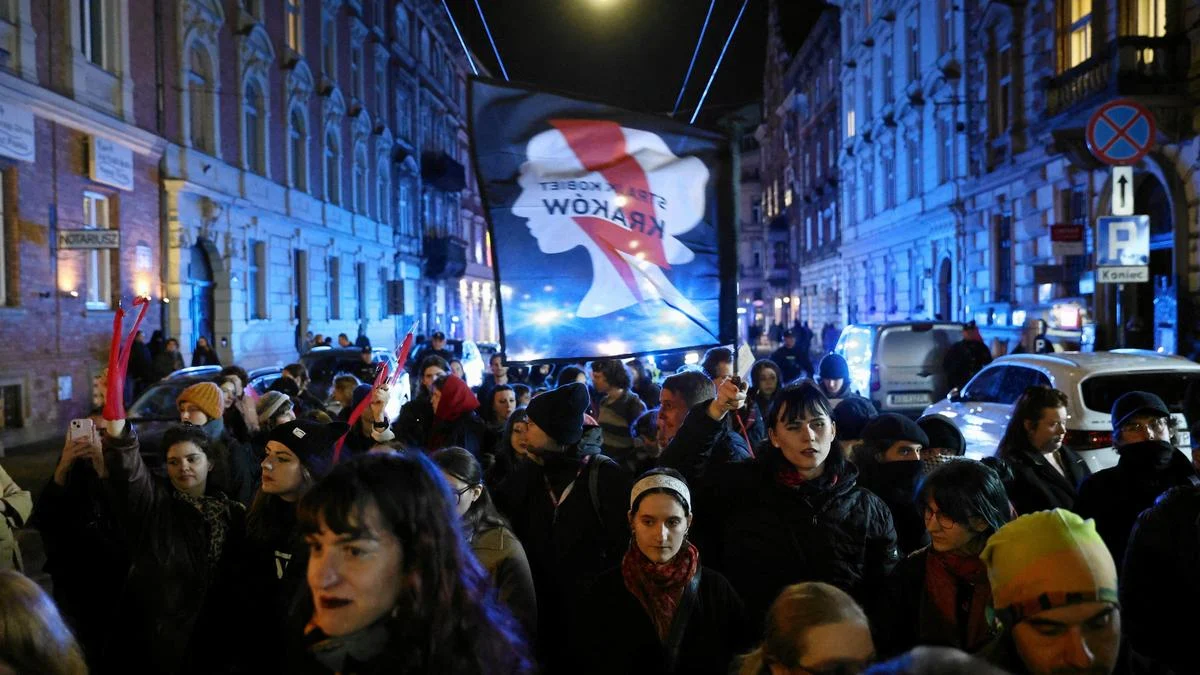
WARSAW — On Thursday, October 22, 2026, the streets surrounding the Polish Parliament (Sejm) in Warsaw were transformed into a sea of umbrellas and raised placards. Despite torrential autumn rain, hundreds of women—joined by thousands of supporters across more than 20 cities—gathered to voice a singular, unified frustration: the continued denial of bodily autonomy in a country where reproductive rights have become the central battleground of democracy.
The protests, which paralyzed parts of the capital, were a direct response to the perceived betrayal of Prime Minister Donald Tusk’s government. When his broad coalition of left-wing and center-right parties swept to power in December 2023, ending the eight-year reign of the national-conservative Law and Justice (PiS) party, they campaigned on a platform of "liberalization." Yet, nearly three years into his term, the promise to restore and expand reproductive rights remains largely unfulfilled. For the protesters, the recent parliamentary movement—two bills passed by the Sejm on October 20—is viewed as a hollow, tactical maneuver rather than the systemic reform required to bring Poland into the 21st century.
A Chronology of Constraint
To understand the anger currently fueling the protests, one must look at the historical erosion of rights in Poland, a nation that has struggled for decades to balance Catholic tradition with modern human rights standards.
- 1993: The "Compromise" era begins. Abortion is restricted to three specific grounds: danger to the mother’s life, rape or incest, or severe fetal abnormalities.
- October 2020: The Constitutional Tribunal, stacked with conservative appointees, rules that abortion due to fetal abnormalities is unconstitutional. This effectively eliminates the most common legal ground for termination, triggering the largest wave of protests in post-communist Poland.
- January 2021: The ruling takes effect, creating a de facto near-total ban.
- December 2023: Donald Tusk’s coalition takes office, promising to overturn the restrictions.
- October 20, 2026: The Sejm passes two bills intended to ease restrictions, though they fall far short of "abortion on request."
- October 22, 2026: Nationwide protests erupt as citizens demand more than the current legislative "tokenism."
The Legal Landscape: Navigating a Near-Total Ban
Poland’s current legal framework is among the most restrictive in the European Union. Under the current interpretation of the law, a woman can only legally obtain an abortion if her life or health is at risk, or if the pregnancy is the result of a criminal act (rape or incest). Even in these cases, the law is notoriously difficult to navigate.
The psychological and medical chilling effect is perhaps the law’s most potent weapon. The criminalization of anyone who assists in an abortion—carrying a penalty of up to three years in prison—has created an atmosphere of fear among medical professionals. Doctors, fearing legal retribution or professional ruin, often refuse to perform even life-saving procedures, leading to tragic outcomes. While the woman undergoing the procedure is not criminally liable, the systemic barriers to access often force those in need to travel abroad or rely on dangerous, underground channels.
The Legislative Proposals: Progress or Palliative?
The two bills passed on October 20 have become the flashpoint of the current debate. Proponents of the government claim these bills represent the "art of the possible" in a deeply divided parliament. Critics, however, view them as a political hedge.
1. The Decriminalization Bill: This measure seeks to remove criminal penalties for doctors and those who assist in a termination performed with the woman’s consent. It provides a legal shield for medical staff acting in good faith to protect a woman’s health or in cases of severe, irreversible fetal abnormalities. By removing the threat of imprisonment, the bill aims to alleviate the "chilling effect" in hospitals.
2. The Restoration Bill: This seeks to bring back the legal grounds for abortion in cases of fetal abnormality—essentially undoing the 2020 Constitutional Tribunal ruling.
While these bills are technically progressive, they do not touch the underlying prohibition of abortion on request. They are, at best, a return to the status quo of 1993, which many activists argue was already insufficient. With President Karol Nawrocki—a conservative figure—widely expected to veto these measures, the legislative path forward is obstructed. Many see the government’s sudden interest in these bills not as a commitment to women’s rights, but as a cynical effort to boost polling numbers ahead of the 2027 parliamentary elections.
International Context: How Europe Compares
The disparity between Poland and its European neighbors is stark. While Poland remains locked in a conservative paradigm, the rest of the continent has moved toward broader access.
- France: In 2024, France set a global standard by enshrining the right to abortion in its Constitution. It permits abortion on request up to 14 weeks, with the state covering all costs.
- Sweden: A model of accessibility, Sweden allows abortion on request up to 18 weeks, with medical abortions frequently performed at home, fully subsidized by the state.
- The Netherlands: Known for its liberal framework, the Netherlands allows abortions up to the point of fetal viability, typically around 24 weeks, based on medical assessment.
- Ireland: Since its 2018 referendum, Ireland has transitioned from one of the most restrictive regimes to a system that allows abortion on request up to 12 weeks, signaling a massive cultural shift.
- Malta: The only other European nation that mirrors Poland’s struggle. Though Malta recently introduced narrow exceptions for life-saving procedures, it remains a heavily restricted environment, underscoring that the fight for bodily autonomy is not limited to Warsaw.
Official Responses and Political Implications
The political response to the October 22 protests has been tepid. Government spokespeople have emphasized the "complexity" of the legislative process and the need to respect the "veto powers of the President." This bureaucratic language has only served to further alienate the protesters, who argue that the coalition has the mandate—but lacks the courage—to push for more substantive change.
For the opposition, the protests are an opportunity to highlight the government’s instability. For the protesters themselves, the issue is beyond politics; it is a matter of basic human rights. The movement is now demanding not just the passage of the two current bills, but a constitutional guarantee of reproductive freedom and the total separation of church influence from public health policy.
Conclusion: A Future in Flux
As the rain continues to fall in Warsaw, the message from the streets is clear: the "compromise" of 1993 is no longer acceptable to a new generation of Poles. The government finds itself in a precarious position. By failing to deliver on its promises, it risks losing the support of the very demographic that brought it to power. Conversely, by pushing too hard for reform, it faces the ire of the conservative religious establishment and a hostile presidential office.
As the 2027 election cycle looms, the abortion issue has solidified as the definitive test of the Tusk administration’s integrity. For the women of Poland, the legislative dance in the Sejm is a secondary concern; their struggle is for the right to control their own lives, a struggle that appears destined to continue until the laws of the land align with the values of a modern, democratic society. Whether the current administration will rise to meet this challenge or crumble under the pressure of political inertia remains the most critical question in Polish politics today.