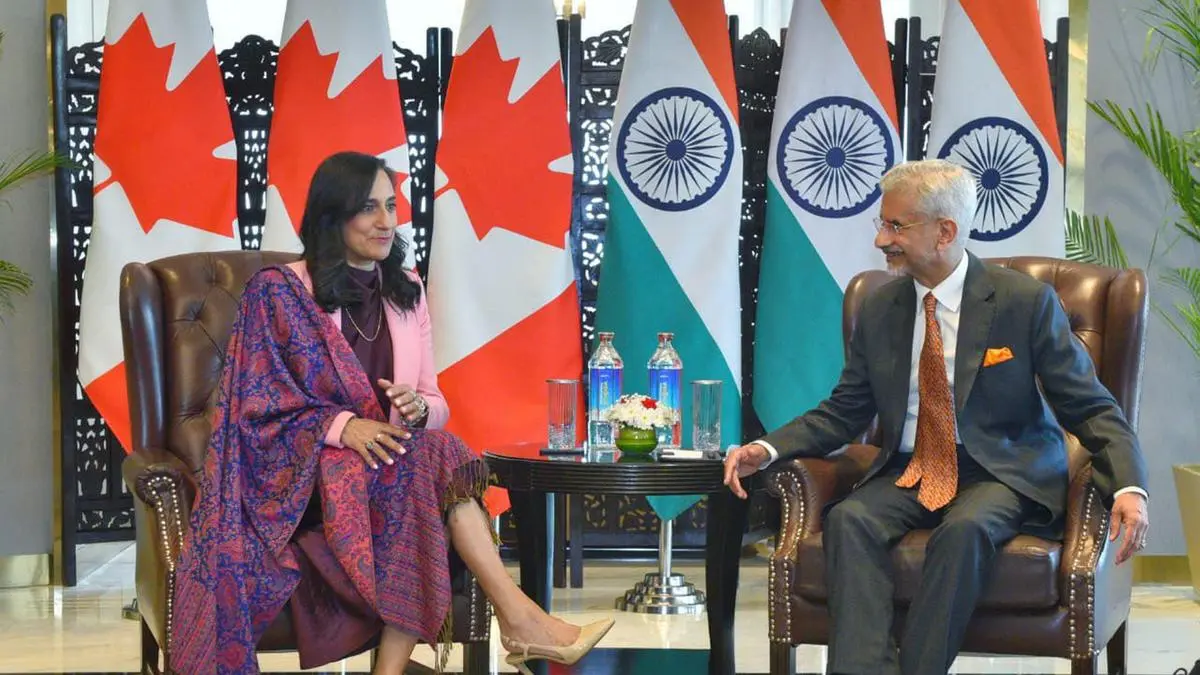
New Delhi – In a significant diplomatic push to solidify relations, External Affairs Minister S. Jaishankar and his Canadian counterpart, Anita Anand, held high-level discussions in New Delhi on Wednesday, October 14, 2026. The meeting, which took place amidst a backdrop of global geopolitical volatility, served to reinforce a shared commitment to a “constructive and forward-looking partnership.” Both nations have explicitly signaled an intent to pivot away from past frictions and toward a future defined by tangible economic outcomes and robust security cooperation.
Main Facts: A Renewed Diplomatic Mandate
The core objective of Minister Anand’s working visit to India was to ensure that the "positive momentum" observed over the past year in India-Canada relations is not merely sustained, but translated into concrete policy successes. The meeting between Jaishankar and Anand focused on four strategic pillars: the acceleration of the Comprehensive Economic Partnership Agreement (CEPA), the intensification of security and defense cooperation, energy security, and the solidification of people-to-people ties.
Both ministries issued readouts characterizing the meeting as productive. Canada emphasized the strategic importance of India as a “valuable partner” in an era of global uncertainty, while the Indian Ministry of External Affairs (MEA) highlighted the mutual desire to finalize long-pending trade negotiations. This meeting also follows closely on the heels of a “warm and productive” telephonic conversation between Prime Minister Narendra Modi and Canadian Prime Minister Mark Carney, further underscoring the political will at the highest levels of government to harmonize the two nations’ trajectories.
Chronology: The Road to Reconciliation
The trajectory of India-Canada relations over the last 18 months has been one of deliberate recalibration. Following a period of strained communication, both nations initiated a systematic effort to rebuild trust.
- October 2025: During Minister Anand’s inaugural visit to India, the two nations launched a "joint roadmap" designed to provide a framework for cooperation in key sectors, including technology, clean energy, and trade.
- Early 2026: Increased frequency of bilateral exchanges at the bureaucratic and ministerial levels began to lay the groundwork for a more stable relationship.
- October 2026 (The Preceding Week): The fifth round of negotiations for the CEPA concluded in Ottawa, with officials from both sides describing the discussions as constructive and focused on mutual benefit.
- October 13, 2026: Prime Minister Modi and Canadian Prime Minister Mark Carney held a high-level telephonic dialogue, reaffirming the goal of doubling two-way trade by 2030.
- October 14, 2026: Minister Anand meets with PM Modi and EAM S. Jaishankar in New Delhi to solidify these commitments.
CEPA Talks and the Vision for 2030
Central to the economic discussions was the Comprehensive Economic Partnership Agreement (CEPA). For both nations, the CEPA is viewed as the cornerstone of a deeper economic integration. Trade ministers from both countries are currently navigating the complexities of market access, intellectual property, and service sector integration.
MEA spokesperson Randhir Jaiswal recently confirmed that the fifth round of negotiations in Ottawa was a critical step in identifying common ground. The ambition to double two-way trade by 2030 remains the "North Star" for both administrations. Canada, in particular, is looking to India as a key market to diversify its trade portfolio, while India sees Canadian investment in green energy and technology as a vital component of its own economic growth story.
The "Team Canada" Trade Mission, led by International Trade Minister Maninder Sidhu, was cited by both ministers as a successful model for this expansion. By integrating private sector initiatives with government-led negotiations, both countries are attempting to create a "bottom-up" economic resilience that is less susceptible to political cycles.
Official Responses and Strategic Convergence
The official readouts from both Ottawa and New Delhi reveal a high degree of convergence on global affairs. In addition to bilateral issues, the ministers conducted a "detailed exchange of views" on the ongoing conflict in the Middle East and the war in Ukraine.
Minister Anand, representing the Canadian government, emphasized that in a world marked by "geopolitical uncertainty," India’s role as a stabilizing force is increasingly recognized by Ottawa. This marks a pivot from previous years where the focus was often dominated by specific, localized issues. By broadening the scope of the dialogue to include global security, the two nations are positioning themselves as partners in a broader, rules-based international order.

Furthermore, the recent national security adviser (NSA)-level dialogue held in India was highlighted as a major achievement. By establishing a formalized mechanism for security and law enforcement cooperation, both countries are effectively building a "trust-bridge" that allows them to address sensitive issues without derailing the broader economic and diplomatic agenda.
Implications for the Future: A Partnership of Necessity
The implications of this renewed cooperation are manifold. For the Indian diaspora in Canada—one of the largest and most influential in the world—this rapprochement promises greater stability in travel, education, and business exchanges. For the Canadian government, aligning with India is a key component of its "Indo-Pacific Strategy," recognizing that India’s economic trajectory is essential for Canada’s long-term prosperity.
Security and Defense Cooperation
The discussions also touched upon expanding defense cooperation. While still in its nascent stages compared to other strategic partnerships, both sides expressed an interest in sharing maritime domain awareness and enhancing coordination in the Indian Ocean and Arctic regions. The commitment to "sustained engagement" on security matters suggests that both governments are moving toward a more transparent and institutionalized intelligence-sharing and policy-coordination framework.
Energy and Technology
As both nations move toward net-zero targets, the potential for collaboration in clean energy technology has emerged as a primary driver of the bilateral agenda. India’s massive energy transition requirements offer a significant opportunity for Canadian firms specializing in nuclear energy, hydrogen, and renewable infrastructure. Simultaneously, India’s burgeoning tech ecosystem is increasingly attracting interest from Canadian venture capital and research institutions.
Challenges Ahead
Despite the clear political momentum, observers note that challenges remain. The process of concluding a trade agreement as complex as the CEPA requires navigating protected sectors in both economies. Furthermore, the volatility of global supply chains and the pressure of domestic political considerations in both Canada and India will require the current leadership to demonstrate consistent, long-term commitment.
However, the tone of the October 2026 meetings suggests a shift toward "pragmatic diplomacy." By focusing on outcomes—tangible trade figures, energy projects, and security milestones—the administrations of Prime Minister Modi and Prime Minister Carney are signaling that they intend to prioritize the national interest over the rhetorical friction of the past.
Conclusion: Sustaining the Momentum
As Minister Anand concludes her working visit, the consensus is that the India-Canada relationship has entered a phase of stabilization. The emphasis on "tangible outcomes" indicates a move away from symbolic diplomacy toward a metrics-driven partnership.
The upcoming high-level engagements, which both sides have agreed to maintain, will be the true test of this renewed commitment. If the two nations can successfully navigate the remaining hurdles in the CEPA negotiations and deepen their security cooperation as planned, the result could be a transformative partnership that serves as a pillar of stability in the Indo-Pacific region. As the world watches, India and Canada are betting on the idea that despite different geopolitical challenges, their shared values and economic synergies provide a compelling case for a deeper, more resilient alliance.