New Delhi, [Date] – For years, the 12% Provident Fund (PF) deduction from salary slips has been a quiet, unwavering presence, a promise of future financial security. However, recent widespread news and social media chatter suggested a radical overhaul of the Employees’ Provident Fund (EPF) system, sparking considerable anxiety among millions of subscribers. Whispers of capped PF contributions, prolonged withdrawal periods, and invalidated nominations fueled a wave of panic. This report aims to provide a comprehensive and definitive explanation of the EPF Scheme 2026, drawing directly from official gazette notifications to clarify what has truly changed, what remains the same, and what these modifications mean for your hard-earned retirement savings.
On June 29, 2026, the Ministry of Labour and Employment enacted a significant legal upgrade, subsuming the decades-old Employees Provident Funds and Miscellaneous Provisions Act, 1952, under the broader Code on Social Security, 2020. This transition has resulted in three distinct, yet interconnected, schemes that collectively govern your retirement security: the Employees’ Provident Funds Scheme, 2026; the Employees’ Pension Scheme, 2026; and the Employees’ Deposit-Linked Insurance Scheme, 2026. Far from a complete replacement, these are detailed rulebooks designed to streamline and clarify existing provisions. For existing members, the transition is seamless; your Universal Account Number (UAN), contribution history, and accumulated benefits carry forward without interruption.
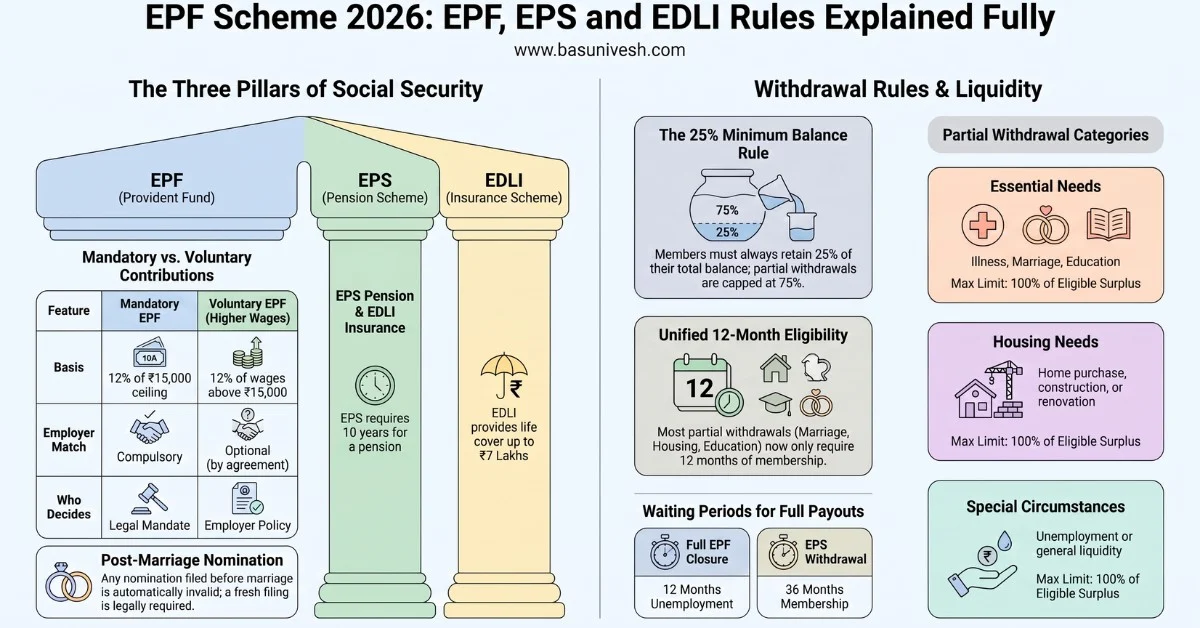
The Pillars of Your Retirement Security: EPF, EPS, and EDLI
It is crucial to understand that your retirement security is not solely dependent on the Provident Fund. It rests on three integrated pillars:
- Employees’ Provident Funds (EPF) Scheme, 2026: This is the core savings component, where your monthly contributions are invested and accumulate with interest.
- Employees’ Pension Scheme (EPS) 2026: This scheme provides a monthly pension after retirement, funded by a portion of the employer’s contribution.
- Employees’ Deposit-Linked Insurance (EDLI) Scheme, 2026: This scheme offers a life insurance cover to members, providing a financial safety net for their families in the event of their demise, at no direct cost to the employee.
The recent gazette notifications have brought about changes and clarifications across all three, aiming to enhance clarity, simplify procedures, and ensure greater accountability.
Unpacking the Changes: What’s New and What’s Familiar
The EPF Scheme 2026 represents a legal evolution rather than a revolution. The fundamental principles of EPF, including contribution rates, the statutory wage ceiling for mandatory contributions, and interest accrual, remain largely consistent. However, the new framework introduces greater precision in defining various contribution types and significantly refines withdrawal procedures.
Key Aspects Remaining Unchanged:
- Contribution Rates: The mandatory employee contribution remains 12% of their basic salary plus dearness allowance, matched by an equal contribution from the employer.
- Wage Ceiling for Mandatory Contributions: The statutory wage ceiling for mandatory EPF contributions remains fixed at Rs. 15,000 per month.
- Interest Rate: The interest rate declared by the EPFO annually continues to apply to EPF accumulations.
- Tax Benefits: EPF contributions, accumulations, and withdrawal benefits continue to enjoy tax exemptions, subject to the standard conditions.
- EPFO’s Role: The Employees’ Provident Fund Organisation (EPFO) continues to be the governing body responsible for the administration of these schemes.
Navigating the Nuances: Mandatory EPF vs. Voluntary Contributions
A significant source of confusion surrounding the EPF Scheme 2026 stems from the distinction between mandatory and voluntary contributions, particularly concerning higher wages. The new scheme clearly delineates these into two distinct categories:
Mandatory EPF Contribution:
This portion of your contribution is strictly linked to the statutory wage ceiling of Rs. 15,000. Regardless of your actual salary, the legally mandated employee and employer contributions are calculated on this ceiling.
- Employee Contribution: 12% of Rs. 15,000 = Rs. 1,800
- Employer Contribution: 12% of Rs. 15,000 = Rs. 1,800
This Rs. 3,600 per month constitutes the non-negotiable, legally compulsory portion of EPF contributions for all covered employees. No employer can refuse to contribute this minimum amount.
Voluntary EPF on Higher Wages:
For employees whose basic salary exceeds Rs. 15,000, the contributions made on the amount above this ceiling are now formally classified as "voluntary contribution on higher wages." This signifies a shift from the previous practice where employers often automatically continued contributions on the full salary.
- Employee Contribution: 12% of wages above Rs. 15,000 (if opted for).
- Employer Contribution: This is no longer automatic. The employer has the discretion to:
- Continue matching the contribution on full higher wages.
- Partially reduce their contribution above the ceiling.
- Restrict their contribution strictly to the Rs. 15,000 ceiling.
Crucially, both the employee and employer can choose to reduce or discontinue these voluntary contributions at any time. Employees are strongly advised to consult their HR departments to understand their organization’s policy on this matter.
Voluntary Provident Fund (VPF): The Employee’s Choice
Distinct from both mandatory and voluntary contributions on higher wages, the Voluntary Provident Fund (VPF) remains an avenue for employees to contribute additional funds over and above their regular EPF.
- Employee Contribution: Any additional amount chosen by the employee.
- Employer Contribution: No employer matching is provided for VPF.
VPF continues to be a highly attractive option for building a substantial retirement corpus due to its tax-efficient nature, earning the same EPF interest rate and enjoying similar tax treatment, subject to the standard five-year continuous service condition for tax-free withdrawals.
Comparative Analysis of Contribution Types:
| Feature | Mandatory EPF | Voluntary EPF on Higher Wages | Voluntary Provident Fund (VPF) |
|---|---|---|---|
| Contribution Basis | 12% of Rs. 15,000 wage ceiling | 12% of wages above Rs. 15,000, by agreement | Additional employee contribution |
| Employee Contribution | Mandatory | Voluntary | Voluntary |
| Employer Contribution | Mandatory | Only if employer agrees | No employer matching |
| Decision Maker | Law | Employer policy or mutual agreement | Employee alone |
Streamlined Withdrawal Procedures: Simplifying Access to Funds
One of the most significant and welcome changes under the EPF Scheme 2026 concerns withdrawal rules. Gone are the numerous specific reasons for partial withdrawals, replaced by a more consolidated and accessible framework.
Three Broad Categories for Partial Withdrawals:
Under Para 46 of the EPF Scheme 2026, all reasons for partial withdrawals have been grouped into three main categories. Each category is capped at 100% of the "eligible member surplus," defined as the total EPF balance minus a mandatory 25% minimum balance that must always be retained.
-
Special Circumstances: This category encompasses a wide range of needs, including unemployment, natural calamities, and specific personal emergencies. Crucially, members who leave employment before completing 12 months of membership are still eligible to apply for partial withdrawals under this provision, capped at their eligible surplus on the claim date. This offers immediate liquidity for early-career professionals facing unforeseen circumstances.
-
Specific Purposes: This category covers withdrawals for planned expenditures such as purchasing or constructing a house, repaying a home loan, purchasing land, renovating a house, or for marriage expenses.
-
Financial Distress: This category addresses situations arising from financial hardship, such as medical emergencies, educational expenses for children, or the establishment of self-employment ventures.
The Uniform 12-Month Membership Requirement:
A significant simplification is the introduction of a uniform minimum of 12 months of EPF membership for most partial withdrawal categories. This replaces the older, more stringent requirements of 5 to 7 years of service that were previously applicable for specific purposes like house purchases or weddings. This change offers substantial relief to early-career professionals and individuals who frequently switch jobs.
The Crucial 25% Minimum Balance Rule:
While partial withdrawals have become more accessible, the EPFO has implemented a safeguard to ensure a minimum level of savings is always retained. Members must maintain at least 25% of their total EPF balance, termed the "minimum balance." All partial withdrawals, irrespective of the category, are capped at 100% of the eligible surplus. In practical terms, this means a maximum of 75% of your total EPF balance can be accessed through any partial withdrawal.
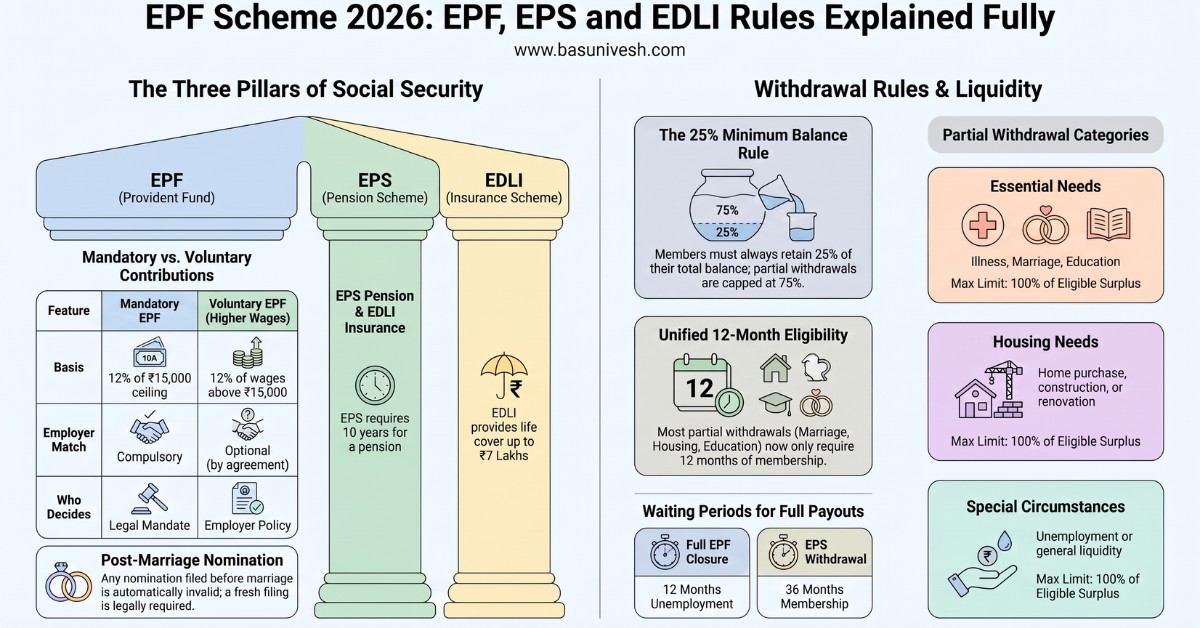
Example: If your total EPF balance is Rs. 8 lakh, your minimum balance is Rs. 2 lakh (25% of Rs. 8 lakh). Your eligible surplus is Rs. 6 lakh, which represents the absolute ceiling for any partial withdrawal.
Navigating Job Loss: Clarity on Full Closure and Partial Access
The procedures following job loss have been a focal point of recent discussions. The EPF Scheme 2026 provides distinct provisions for full account closure and partial withdrawals, requiring careful understanding to avoid misinterpretations.
Full Account Closure: The 12-Month Bar
Para 49 of the EPF Scheme 2026 outlines the conditions for complete withdrawal, i.e., closing your EPF account. While certain specific situations like retirement after age 55, permanent incapacity, or migration abroad have their own defined waiting periods, the general rule for individuals who resign or are retrenched outside these categories is clear:
- 12-Month Continuous Non-Employment: You are eligible to apply for full withdrawal only if you have remained out of employment continuously for at least 12 months immediately preceding your application. This is a definitive waiting period, not a staged payout.
- Exemption for Women Resigning for Marriage: Women who resign specifically for the purpose of marriage are exempted from this 12-month waiting period.
Immediate Liquidity: The Power of Partial Withdrawal
The widely discussed "75% immediately" figure following job loss actually refers to the general partial withdrawal ceiling under Para 46. This provision, particularly under the "Special Circumstances" category, is available to you even if you have not completed 12 months of employment or have not yet met the 12-month non-employment criterion for full closure.
- Access up to 75% of Balance: You can access up to 75% of your EPF balance almost immediately through a Special Circumstances partial withdrawal, which explicitly covers unemployment.
- Full Closure Requires 12-Month Wait: The 12-month waiting period is exclusively for the complete closure of your EPF account and withdrawal of the remaining balance.
Therefore, in the event of job loss, you have two distinct options: immediate access to a substantial portion of your funds through partial withdrawal, or a waiting period of 12 months for full account closure.
EPS 2026: Unpacking Pension Rules and Withdrawal Benefits
The Employees’ Pension Scheme (EPS) operates under a separate set of rules from EPF, and understanding these distinctions is crucial, especially when transitioning between jobs.
What Remains Unchanged in EPS:
- Mandatory Contributions: The employer’s contribution of 8.33% of the pensionable salary (capped at Rs. 15,000) continues to fund the EPS.
- Pensionable Salary Calculation: Pensionable salary is typically calculated as the average of the last 60 months of contribution.
- Pensionable Service: This refers to the period for which contributions have been made to the EPS.
- Pension Age: The normal age for receiving a monthly pension remains 58 years.
- Scheme Certificate: Members with more than 10 years of pensionable service can obtain a Scheme Certificate to preserve their service for future pension benefits if they join another EPF-covered employer.
EPS Withdrawal Benefit: A Distinct and Longer Wait
For members who leave a job with less than 10 years of eligible EPS service, a withdrawal benefit (a lump sum) is available instead of a monthly pension. However, the eligibility to claim this benefit is subject to a significantly longer waiting period than that for EPF withdrawals.
- 36-Month Waiting Period: As per Para 13 of the EPS Scheme 2026, this withdrawal benefit can only be claimed after a continuous period of 36 months has elapsed from the date your last contribution became due, or upon attaining superannuation, whichever is earlier. This is a crucial distinction from the EPF’s 12-month bar for full closure.
- No Withdrawal for Over 10 Years of Service: If your EPS service has already crossed 10 years, you are not eligible for this withdrawal benefit. Your entitlement is solely to a monthly pension from age 58 or a Scheme Certificate.
In summary, after job loss: your EPF full balance is locked for 12 months (with partial withdrawal available earlier), while your EPS lump sum benefit (if eligible) is locked for 36 months. These are two separate timelines governed by distinct rules.
Pension Claim Accountability:
Para 17 of the EPS Scheme, mirroring the EPF provisions, mandates that complete pension claims must be settled within 20 days of receipt. Any deficiencies must be communicated within the same period. Failure to settle a claim within this timeframe without sufficient cause incurs a penal interest of 12% per annum, recoverable from the Commissioner’s salary, ensuring timely resolution for pensioners.
EDLI 2026: A Precise Formula for Life Insurance Cover
The Employees’ Deposit-Linked Insurance (EDLI) Scheme provides a vital life insurance benefit to EPF members, funded entirely by employers. The EDLI Scheme 2026 introduces a more precise formula for calculating the payout.
The Base Benefit Calculation:
The base benefit is determined by the average balance in your EPF account over the preceding 12 months (or your entire membership period if shorter).
- Formula: Rs. 50,000 + (40% of average EPF balance above Rs. 50,000)
- Cap: This base benefit is capped at Rs. 1,00,000.
- Additional Bonus: A 20% bonus is applied specifically to this base benefit calculation.
The Enhanced Benefit (for Continuous Employment):
If the member was in continuous employment for a full 12 months immediately preceding their death, a more generous formula applies:
- Formula: (Average monthly wages, capped at the notified wage ceiling) multiplied by 35, plus 50% of your average EPF balance.
- Wage-Linked Component Cap: This combined wage-linked component is capped at Rs. 1,75,000.
- Guaranteed Payout: The total payout under this enhanced formula is guaranteed to be between Rs. 2,50,000 and Rs. 7,00,000.
Your family will receive the higher of the two calculated amounts (base benefit with bonus or the enhanced benefit). It is important to note that the 20% bonus is applied only to the base benefit calculation and does not stack on top of the enhanced wage-linked formula.
Nomination and Claims:
A single nomination filed for your EPF account automatically covers your EDLI payout. This underscores the importance of keeping your nomination updated. EDLI claims follow the same stringent 20-day settlement timeline with a 12% penal interest for delays, ensuring uniformity across all three schemes.
Crucial Updates: Nominations and Digital Records
Post-Marriage Nomination Requirement:
A significant procedural change mandates that any nomination made prior to marriage is automatically considered invalid upon marriage. You are required to file a fresh nomination after your marriage. This updated nomination is crucial not only for EPF but also for the EDLI payout. Failure to do so can lead to significant delays and complications for your family in claiming benefits. If you currently have no family, you must file a fresh nomination the moment you acquire one.
Digital Compliance and KYC:
The 2026 schemes emphasize digital compliance. Ensuring your Aadhaar, PAN, and bank account details are correctly linked and KYC-verified against your UAN is paramount. Employers are now mandated to upload monthly electronic returns within 15 days of month-end, and all claims are expected to be filed electronically. Incomplete or inaccurate digital records are a primary cause of claim delays, and maintaining current KYC details is now squarely the subscriber’s responsibility.
Inoperative Accounts:
EPF accounts that become payable (e.g., on retirement) and remain unclaimed for 36 months are marked "inoperative" and cease to earn interest. Prompt claim filing is essential to prevent your accumulated savings from becoming dormant and losing their growth potential.
Your Action Checklist: What You Should Do Now
- Review Your Nomination: Log into the EPFO Unified Member Portal and update your nomination, especially if you have recently married, had a child, or experienced a family bereavement.
- Verify Your KYC Details: Ensure your Aadhaar, PAN, and bank account are accurately linked to your UAN.
- Understand Your Employer’s Policy: Clarify your employer’s stance on contributions above the Rs. 15,000 wage ceiling.
- Familiarize Yourself with Withdrawal Rules: Understand the categories for partial withdrawals and the 25% minimum balance rule.
- Consult HR for Job Transitions: Be aware of the differing timelines for EPF and EPS withdrawals upon leaving employment.
- Stay Informed: Keep abreast of any future announcements or clarifications from the EPFO.
The Bottom Line: Evolution, Not Revolution
The EPF Scheme 2026, alongside the EPS and EDLI Schemes, signifies a procedural and administrative evolution rather than a fundamental shift in how your retirement savings operate. Contribution rates, the wage ceiling, interest rates, pension formulas, and tax benefits remain largely unchanged. The core enhancements lie in:
- Simplified EPF Withdrawal Categories: Making access to funds more straightforward.
- Uniform 12-Month Eligibility: Reducing waiting periods for partial withdrawals.
- Protective 25% Minimum Balance: Ensuring a core savings buffer.
- Clearer Timelines for Job Loss: Differentiating EPF and EPS withdrawal periods.
- Precise EDLI Payout Formula: Providing greater clarity for beneficiaries.
- Mandatory Accountability Timelines: Enhancing EPFO’s responsiveness.
- Updated Nomination Rules: Ensuring continuity of benefits for dependents.
These changes, while requiring a degree of adaptation, are designed to foster greater transparency and efficiency. The key takeaway for subscribers is to move from passive participation to active engagement. By understanding these updated regulations, verifying your details, and proactively managing your accounts, you can ensure your EPF and EPS corpus continues to grow for a secure retirement, while your EDLI cover provides essential protection for your loved ones.